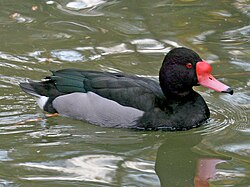
The Rosy-billed Pochard is the undisputed king of South American waterfowling, a massive, heavy-bodied diving duck that provides international sportsmen with spectacular, close-range decoying action across the unpressured winter marshes of Argentina.
The Heavyweight of the Flyway
For the traveling wingshooter, the Rosy-billed Pochard (*Netta peposaca*) is the ultimate prize of the morning marsh. Known locally as the *Rosao* due to the drake's spectacular, bulbous bright crimson bill, this species is structurally massive—approaching the physical weight and size of a North American Canvasback. Despite belonging to the diving duck family, the Rosy-bill feeds heavily on agricultural seeds and aquatic vegetation in shallow water. They migrate northward from the sub-Antarctic lakes of Patagonia every winter, swarming the flooded pastures of Buenos Aires, Entre Ríos, and Santa Fe in massive, tightly bunched flocks.
Species ProfileRosy-Billed Pochard (Netta peposaca)Visual Identification (Drake)Jet-black chest and head, purplish-sheen back, bulbous rosy-red bill.Flight ProfileAggressive, direct, low-altitude flights; capable of immense air speeds.Decoying SophisticationHighly visual; commits with absolute aggression to large spreads without circling.Ammunition MandateNon-toxic steel or bismuth ONLY; heavy payload required.
Conquering the Armored Target
Hunting the Rosy-bill requires a significant ballistic step up from the afternoon dove roost. Because these ducks migrate through extreme cold fronts, they develop an incredibly dense layer of insulating down and thick winter feathers that acts as a natural body shield. Firing light, low-velocity target loads will merely wound the bird, leading to frustrating lost game in the deep reeds. To secure clean, ethical harvests, you must utilize a 12-gauge shotgun loaded with high-velocity non-toxic steel shot in sizes #3 or #4, paired with a Light Modified choke to deliver devastating downrange energy as the birds back-pedal over the decoys.
Tactical Field Note: Rosy-billed Pochards are notoriously durable cripples. If a downed bird hits the water with its head up, it will instantly submerge like a true diver, swimming hundreds of yards underwater into the dense cattails where even an elite Labrador cannot recover it. You must apply an immediate, secondary "water-shot" the moment a crippled bird touches the water to ensure a clean recovery.
Internal Connections
- Compare their behavior to northern targets via Rosy-Billed Pochard vs Mallard: Waterfowl Comparison.
- Understand the legal daily quotas in Duck Hunting Bag Limits in Argentina: Conservation and Ethics.
- Review the marsh setups used for them in Duck Hunting Decoys, Blinds, and Waders in Argentina.