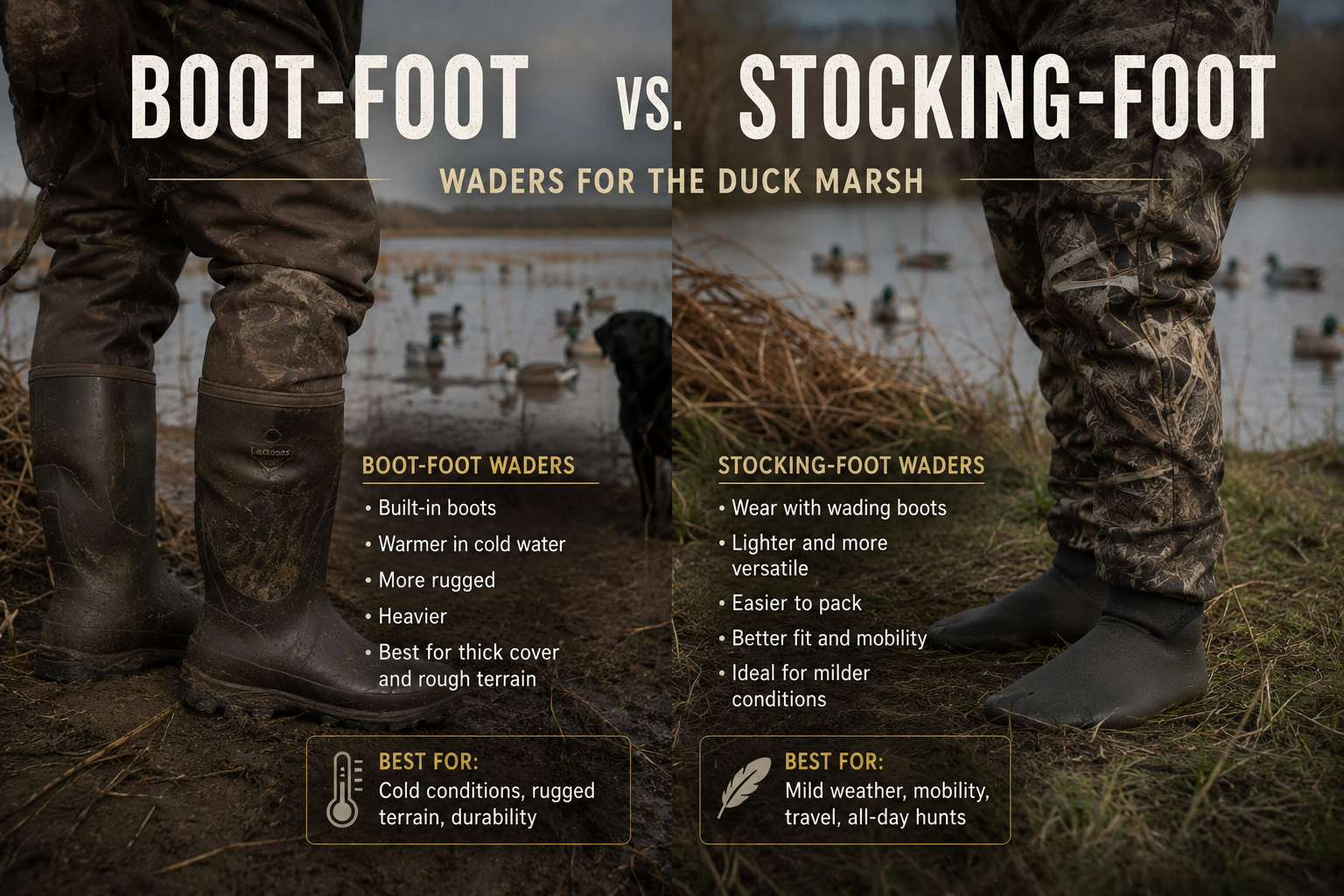
Navigating the incredibly adhesive, boot-sucking mud of the Argentine duck marsh requires international waterfowlers to make a critical footwear decision, pitting the convenience of traditional boot-foot waders against the lightweight mobility of the stocking-foot system.
The Threat of the 'Barro'
The mud (barro) in the Paraná Delta and the flooded pastures of Buenos Aires is notoriously thick and viscous. When you step into the marsh to walk to your sunken blind, the mud creates a massive suction vacuum around your foot. If your footwear is not perfectly secured, pulling your leg upward will rip your foot entirely out of your boot, leaving you standing in freezing water in just your socks. This environmental reality dictates how you armor your lower half against the 30°F (-1°C) winter water.
Wader TypeDesign StructurePerformance in Argentine MudBoot-Foot WadersRubber boot permanently fused to the wader leg.Excellent. Cannot be pulled off by the mud; bulky to pack.Stocking-Foot WadersNeoprene sock; requires a separate lace-up wading boot.High Risk. If boots are not laced incredibly tight, the mud will pull them off.
The Logistical Compromise
From a purely tactical field perspective, Boot-Foot waders are the supreme choice for Argentina. Because the heavy rubber boot is vulcanized directly to the Gore-Tex or Neoprene leg, the mud cannot steal your shoe. You simply stomp through the swamp with absolute confidence. However, boot-foot waders are massive, heavy, and incredibly difficult to pack into a checked airline duffel bag. Stocking-Foot waders (used widely by fly fishermen) pack down incredibly small. If you choose stocking-foot waders to save luggage weight, you must bring dedicated, heavy-duty wading boots and lace them with brutal tightness. Furthermore, you must fold down the integrated gravel guards to prevent the abrasive mud and silt from working its way between the boot and the neoprene sock, which will quickly rub holes in the waterproof material.
Tactical Field Note: Do not buy brand-new, ultra-insulated 1000-gram Thinsulate boots for Argentina. You are not standing in frozen ice like in Canada. The extreme bulk of heavily insulated boots makes walking through the thick mud exhausting. Uninsulated rubber boots, paired with two layers of premium Merino wool socks, provide the perfect balance of warmth and lightweight mobility.
Internal Connections
- See the rest of the clothing required for the cold in The 3-Layer System for Argentina Winter Duck Hunting.
- Understand how you protect these waders from wire via Torn Waders: Surviving Submerged Barbed Wire in the Pampas.
- Read about the luggage limits that make packing hard in Domestic Airline Baggage Limits for Argentina Hunters.