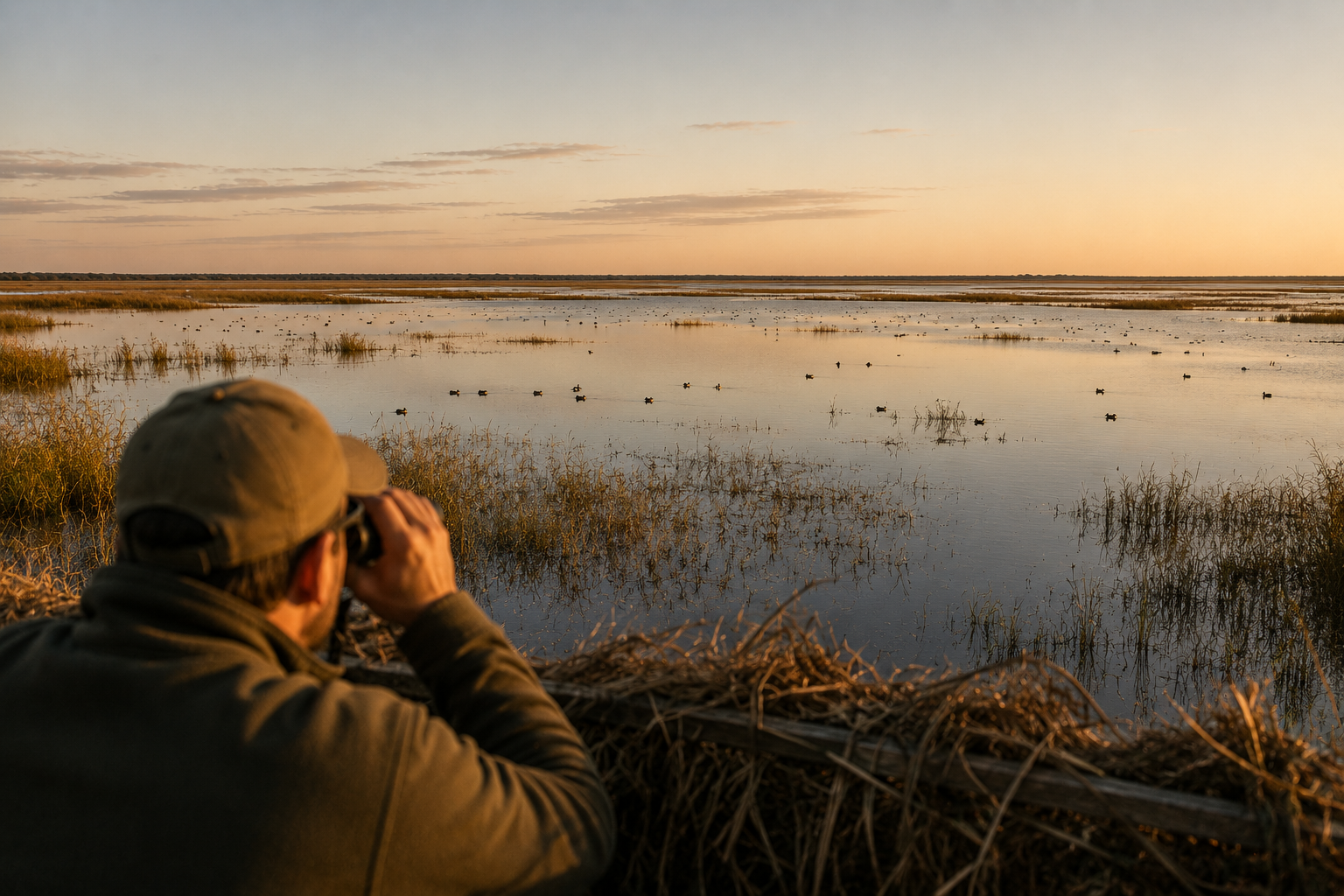
Success in Argentina duck hunting is dictated by the arrival of Antarctic cold fronts (Antártida pulses) and the stable flooding of agricultural pastures, requiring hunters to deploy exclusively during the June-to-August peak when dropping temperatures push large waterfowl concentrations into the Humid Pampa. Rainfall levels from the preceding summer determine the water depth in the lagoons, directly impacting whether outfitters utilize static sunken blinds or mobile mud boats.
The Pulse of the Cold Front
In the Southern Hemisphere, the "migration" is triggered by cold air pushing up from the south. When a strong winter storm hits Patagonia, millions of Rosy-billed Pochard and Teal funnel north into the central provinces. For the hunter, a 30-degree morning with a 15-knot south wind is the absolute tactical ideal. These conditions keep the birds moving and vocal, ensuring they decoy aggressively into the sheltered pockets of the marsh.
| Environmental Factor | Impact on Waterfowl | Tactical Adjustment |
|---|---|---|
| Strong South Wind | Birds fly low; decoy aggressively. | Set decoys in protected 'lee' water. |
| Heavy Summer Rains | lagoon levels are high; boats required. | Deploy via mud boats; use deep-water spreads. |
| Severe Winter Frost | Kills marsh grass; opens flight lines. | Improve blind camouflage; birds become more wary. |
| Morning Fog | Birds fly late; low visibility. | Wait for the 'burn-off'; use vocal calling. |
Managing the Water Depth
Argentina's waterfowl habitat is dynamic. In "dry" years, ducks concentrate in permanent lagoons and river deltas (Santa Fe), requiring boat-in access. In "wet" years, the pampas pastures (Buenos Aires) flood, creating thousands of temporary shallow-water ponds that draw birds closer to the estancia gates. Your outfitter monitors these levels months in advance to determine which blinds will be operational for your specific dates.
Hunting the Ringed Teal in Argentina: Trophy Waterfowl
The Ringed Teal (Callonetta leucophrys) is one of the most exotic and highly coveted trophy ducks in Argentina, prized by international collectors for the drake's spectacular salmon-colored breast, iridescent green wing speculum, and unique forest-dwelling biology.
The Forest-Dwelling Puddle Duck
To the North American waterfowler, the Ringed Teal is a biological anomaly. While they are technically classified as dabbling ducks, they possess a strong affinity for wooded wetlands and frequently roost in tree cavities, much like a Wood Duck. You will rarely find large flocks of Ringed Teal in the wide-open, treeless pampas of Buenos Aires. Instead, they are typically targeted in the northern and eastern river corridors, particularly in the forested sloughs of the Paraná River Delta in Santa Fe, Entre Ríos, and Corrientes. They travel in very small, intimate groups—often just pairs or flocks of four to six birds.
| Species Profile | Ringed Teal (Callonetta leucophrys) |
|---|---|
| Visual Identification (Drake) | Salmon breast, grey flanks, black-spotted head, green speculum. |
| Habitat Preference | Swamps, slow-moving streams, and forested wetlands. |
| Flight & Decoying | Incredibly agile, weaves through timber, decoys well to small spreads. |
| Trophy Status | experienced; highly sought after for full-service taxidermy mounts. |
Tactical Blind Engagements
Because Ringed Teal travel in such small groups, they do not respond to large, 100-shell open-water decoy spreads the way Rosy-billed Pochards do. Hunting them requires a surgical approach. Guides often set up in tight, sheltered coves or flooded timber margins, utilizing small clusters of puddle duck decoys. When a pair of Ringed Teal commits, they maneuver through the trees with blinding speed and agility. They present a fleeting, close-range target that requires a fast-swinging 12-gauge or 20-gauge and an open Improved Cylinder choke to harvest cleanly without destroying the prized plumage.
Wind Direction and Duck Decoying
In the marshes of Argentina, wind direction is the absolute dictator of waterfowl success, requiring professional guides to construct blinds and position large decoy spreads meticulously to force migrating ducks into a committed, hovering descent directly into the teeth of the breeze.
The Aerodynamics of the Landing Pocket
Ducks operate on strict aerodynamic principles: they must land facing directly into the wind to utilize the air resistance as a brake. Argentine outfitters engineer their entire morning setup around this biological mandate. If the wind is blowing from the North, the guide will position your blind facing South. They will set 50 to 100 full-body decoys in a classic "U" or "J" shape extending outward, leaving a completely empty "kill pocket" directly in front of the blind. As flocks of Rosy-billed Pochards approach, they will circle downwind, turn back into the breeze, and glide perfectly into the empty pocket, presenting a slow, hovering, chest-exposed target at 20 yards.
| Wind Variable | Impact on Waterfowl Behavior | Guide's Tactical Setup |
|---|---|---|
| Steady 10-15 mph Wind | Optimal; birds fly predictably and commit hard. | Sets a clear, defined landing pocket facing into the wind. |
| Dead Calm (0 mph) | Poor; birds fly high and land randomly on the water. | Spreads decoys widely; relies heavily on calling to grab attention. |
| Gale Force (30+ mph) | Chaotic; birds struggle to fly and drop erratically. | Tightens the spread; moves blinds to sheltered lee coves. |
The Magic of the South Wind
While any steady breeze is helpful, the "South Wind" (Viento Sur) is the holy grail of Argentine waterfowl hunting. During the May-to-August season, a strong wind blowing up from Antarctica brings the freezing temperatures of a winter cold front. This large drop in temperature triggers the primary migration, pushing millions of fresh, uneducated ducks northward into Buenos Aires and Santa Fe. A freezing morning with a 15 mph South Wind guarantees that large flocks of Teal and Pochards will be moving aggressively, searching for food and decoying with zero hesitation.
El Niño and La Niña: How Water Levels Impact Duck Hunting
For the experienced international waterfowler, tracking global meteorological cycles is just as important as tracking local fronts; understanding how the El Niño and La Niña phenomena drastically alter Argentina's wetland water levels is critical for selecting the right province.
The El Niño Floods (The Wet Years)
In South America, the **El Niño** weather pattern typically brings large, sustained rainfall across the central and eastern agricultural basins. For duck hunters, this is the golden era of the "flooded pampa." During an El Niño cycle, traditional dry-land pastures and grain fields in Buenos Aires and Entre Ríos become entirely submerged, transforming into large, temporary shallow-water lagoons. This creates millions of acres of fresh habitat. The migrating ducks spread out aggressively, abandoning the deep river systems to feed heavily in these shallow agricultural zones. Hunting is incredibly comfortable, executing decoying shots from dry-bucket blinds right on the edge of flooded alfalfa.
| Weather Cycle | Environmental Impact | Optimal Hunting Deployment |
|---|---|---|
| El Niño (Wet Cycle) | large flooding of agricultural pastures; dispersed bird populations. | Buenos Aires or Entre Ríos (Shallow pasture hunting; dry blinds). |
| La Niña (Dry Cycle) | Severe drought; temporary lagoons vanish; rivers drop. | Santa Fe (Deep river deltas; permanent water concentration). |
| Neutral Year | Average rainfall; predictable localized flooding. | Any full-service mixed-bag province yields excellent results. |
The La Niña Drought (The Dry Years)
Conversely, the **La Niña** cycle introduces severe, prolonged drought to the Argentine interior. The temporary lagoons dry up, and the flooded pastures turn back to hard dirt. During a La Niña year, booking a shallow-water hunt in Buenos Aires can be risky, as outfitters must pump water into artificial ponds to attract birds. However, the drought creates an absolute massacre for hunters deployed in the deep river deltas. Because the permanent arteries of the Paraná River never run dry, every duck migrating north from Patagonia is forced to concentrate directly in the deep river sloughs of Santa Fe or Corrientes. The hunting becomes highly centralized, resulting in spectacular, high-volume decoying action as millions of birds fight over limited aquatic resources.
Hunting the Tides: Water Levels in the Paraná River Delta
Executing a well-organized waterfowl hunt in the vast Paraná River Delta of Santa Fe and Buenos Aires requires international hunters to understand that this ecosystem is not static; it is heavily governed by lunar tides and oceanic wind events that drastically alter the water level.
The Phenomenon of the Sudestada
Because the Paraná River empties into the large Rio de la Plata estuary (which connects directly to the Atlantic Ocean), the lower delta experiences noticeable tidal shifts. However, the most profound impact on the hunting environment is the Sudestada—a strong, sustained wind blowing from the southeast. The Sudestada acts like a wall, physically pushing the Atlantic Ocean into the Rio de la Plata and preventing the Paraná River from draining. Within 24 hours, the water level in the delta can rise several feet, completely flooding the dry islands and reed beds. Conversely, a strong north wind will "blow the water out," leaving large mudflats exposed and turning navigable boat channels into impassable swamps.
| Environmental Variable | Impact on the Delta | Waterfowl Tactical Result |
|---|---|---|
| The Lunar Tide | Predictable, minor daily fluctuations (1-2 feet). | Minor blind adjustments; ducks shift feeding margins slightly. |
| The Sudestada (SE Wind) | large flooding. Water rises rapidly into the brush. | Ducks disperse into newly flooded cover; hunting becomes widespread. |
| Strong North Wind | Drains the delta; exposes vast mudflats. | Highly Concentrated. Ducks are forced into the remaining deep-water channels. |
Blind Adaptation in Dynamic Water
Bañados vs Lagunas: Reading the Argentine Duck Marsh
For the traveling wingshooter, the wetlands of Argentina offer a waterfowl experience unmatched anywhere else on the globe. However, the sheer volume of birds is only half the equation. Success in the blind requires an intimate understanding of the terrain. The Argentine marsh is generally divided into two distinct aquatic environments: the "bañado" and the "laguna." Knowing how to read and hunt these different waters is what separates a established outfitter from a standard hunting camp.
The Bañado: The Flooded Pasture
A bañado is a shallow, often seasonal wetland formed by flooded agricultural pastures or low-lying grassy plains. These are highly dynamic environments, expanding and contracting based on recent rainfall and river fluctuations.
- The Habitat: Bañados are rich in submerged vegetation, seeds, and insects, making them the complete feeding ground for dabbling species like the prized Rosy-billed Pochard, Yellow-billed Pintail, and various Teal.
- The Tactical Approach: Because the water is shallow, hunters are often deployed in small, flat-bottomed aluminum skiffs hidden in tall reeds, or they may stand directly in the water wearing chest waders.
- The Hazards: Hunting a bañado requires caution. Because these are flooded agricultural fields, they frequently conceal submerged barbed-wire fences and uneven cattle ruts, making careful wading and durable wader repair kits absolutely essential.
The Laguna: Open Water Lakes
In contrast, a laguna is a permanent, deeper body of open water. While they may have reedy edges, their centers are wide, wind-swept expanses.
- The Habitat: Lagunas serve as large roosting and resting areas. You will often see thousands of ducks rafted up in the middle of a laguna during the midday hours, taking refuge from predators and resting between feeding cycles.
- The Tactical Approach: Hunting a laguna requires a completely different strategy. The decoys must be highly visible from long distances. Guides will deploy large "V" or "J" hook spreads to pull high-flying flocks down into the landing zone. Blinds are typically built on the solid shorelines or utilize specialized, heavily camouflaged boat blinds anchored on the edges.
- Wind Dynamics: On a laguna, wind is the complete dictator. A strong breeze will create chop on the water, giving your decoys lifelike movement, but it also means the birds will strictly approach the landing zone facing directly into the wind, requiring precise blind placement.
The Estancia Advantage
The complete upscale in Argentine waterfowl hunting is having a logistics team that understands these fluid dynamics. experienced operations rely on full-time scouts who monitor both the bañados and the lagunas daily. Depending on the weather front, the wind direction, and the previous night's rainfall, your guide will calculate exactly which environment offers the highest tactical advantage for your morning deployment.
Related AWSORG Field Intelligence
- Duck Hunting in Argentina: Complete Guide
- What to Pack for Duck Hunting in Argentina
- Shotguns & Non-Toxic Ammunition for Argentina Duck Hunting