Duck hunting in the large Paraná River Delta of Santa Fe and Entre Ríos requires the use of specialized flat-bottom mud boats to navigate treacherous, deep-water sloughs in the pitch black, granting international waterfowlers exclusive access to completely unpressured flocks of migrating Rosy-billed Pochards and Teal.
Navigating the Delta Labyrinth
Unlike the drive-up, shallow-water pastures of Buenos Aires, the Paraná River ecosystem is a rugged, untamed wilderness. It is a large network of tidal islands, thick reed beds, and shifting mudflats. Outfitters utilize heavy-duty skiffs equipped with powerful outboard mud motors (like Go-Devils) to punch through dense aquatic vegetation and shallow sandbars. This deployment is not for the faint of heart; hunters wake up hours before dawn and endure freezing, 30-minute boat rides cut through the biting winter winds to reach the isolated hunting zones.
| Delta Challenge | Outfitter Solution | Hunter Preparation |
|---|---|---|
| Freezing Boat Rides | Large, stable skiffs with windbreaks. | Wear fully windproof Gore-Tex and heavy face masks. |
| Deep River Sloughs | Strategic boat-in positioning. | Pack full-service 5mm neoprene chest waders. |
| Shifting Water Levels | Pre-scouting blind locations daily. | Trust the guide; locations change based on river tides. |
| Remote Bird Retrieval | Trained retrievers and boat pickups. | Never exit the blind into deep mud unassisted. |
Boat Hides vs Island Blinds
Depending on the specific water level of the river that week, your guide will utilize one of two blind strategies. If the water is stable and shallow enough near an island edge, you will step out of the boat into a pre-constructed, brushed-in platform blind hidden in the reeds. If the water is too deep or the birds are feeding on open flats, the guides will utilize the boat itself as the blind, draping it in camouflage netting and driving it directly into the cattails. In both scenarios, the decoy spread is large, ensuring incredible decoying action from ducks that have never encountered a hunter.
Boat Blind Safety Protocols for Argentina Duck Hunting
Hunting the large, deep-water river deltas of Argentina from a floating mud boat provides spectacular waterfowl action, but demands absolute adherence to strict muzzle awareness and seated firing protocols to prevent catastrophic maritime accidents.
The Instability of the Delta Skiff
While hunters in Buenos Aires enjoy the rigid stability of sunken dry blinds, waterfowlers deployed into the Paraná River Delta of Santa Fe or Corrientes often shoot directly from the aluminum hull of a specialized mud boat (*tracker*). The boat is driven deep into a reed bed and covered in camouflage netting. This introduces a severe variable: structural instability. If three hunters stand up simultaneously to fire at a crossing flock of Silver Teal, the sudden shift in weight—combined with the synchronized recoil of three 12-gauge shotguns—can easily capsize the narrow hull, throwing hunters, heavy waders, and loaded firearms into freezing, deep-river currents.
| Boat Blind Threat | Hunter Instinct | Mandatory Safety Protocol |
|---|---|---|
| Sudden Flocks (Teal) | Standing up rapidly to swing the gun. | Remain seated. Execute all shots from your designated stool. |
| Crossing Targets | Swinging the barrel wildly across the boat. | Establish strict firing lanes (Left, Center, Right). Never cross the boat's centerline. |
| Ears & Concussion | Firing while holding the gun inside the hull. | Muzzles must physically extend past the gunwale (edge of the boat) before firing. |
| Loading & Unloading | Loading the gun while climbing into the boat. | Actions must remain open and empty until the boat is fully anchored in the reeds. |
The Muzzle Extension Rule
The most dangerous element of a boat blind is acoustic confinement. When you sit shoulder-to-shoulder with two other hunters and a guide, firing a shotgun while the muzzle is physically inside the footprint of the boat traps the concussive shockwave. If you swing your barrel to track a bird and pull the trigger while the muzzle is just inches away from your partner's head, you can cause permanent, immediate hearing loss or severe physical trauma. You must force yourself to push the muzzle out over the water, past the physical edge of the boat's hull, before you disengage the safety and fire.
Horseback Transfers to the Argentine Duck Blind
While deep-water delta hunts rely on mud boats, traditional shallow-water duck hunting in Buenos Aires Province frequently utilizes native Criollo horses, providing a highly efficient, culturally immersive transfer across flooded agricultural pastures to the morning blinds.
The Logistics of the Flooded Pampa
In regions where the agricultural plains flood temporarily from winter rains, outfitter trucks cannot reach the hunting zones without sinking into the deep, loamy mud. Walking a mile through shin-deep water in heavy neoprene waders while carrying a shotgun and blind bag is an exhausting way to start a morning. To solve this, experienced outfitters partner with local *gauchos* (Argentine cowboys) to maintain strings of native Criollo horses. These horses are specifically bred for the pampas—they are short, incredibly sturdy, and completely unbothered by water, mud, or the sound of distant gunfire.
| Transfer Method | Terrain Application | Hunter Experience |
|---|---|---|
| Mud Boats (Go-Devils) | Deep river deltas and tidal sloughs (Santa Fe). | Freezing, fast-paced water transit. |
| 4x4 Trucks | Dry field edges and dove roosts. | Comfortable, direct access. |
| Criollo Horses | Shallow flooded pastures and bogs (Buenos Aires). | Silent, low-impact, traditional transit. |
The Pre-Dawn Ride
The horseback transfer is a highlight of the Argentine waterfowling tradition. At 5:30 AM, your VIP van drops you at the edge of the paved road. The gauchos are waiting with saddled horses. You hand your unloaded shotgun to the guide, swing into the traditional sheepskin-lined saddle, and ride silently through the dark, flooded marsh for 15 to 20 minutes. The horses navigate the hidden badger holes and deep mud effortlessly. They drop you precisely at the edge of your sunken dry blind, ensuring you arrive completely dry, rested, and physically ready for the morning flight.
Floating Gun Cases: Protecting Shotguns in the Mud Boat
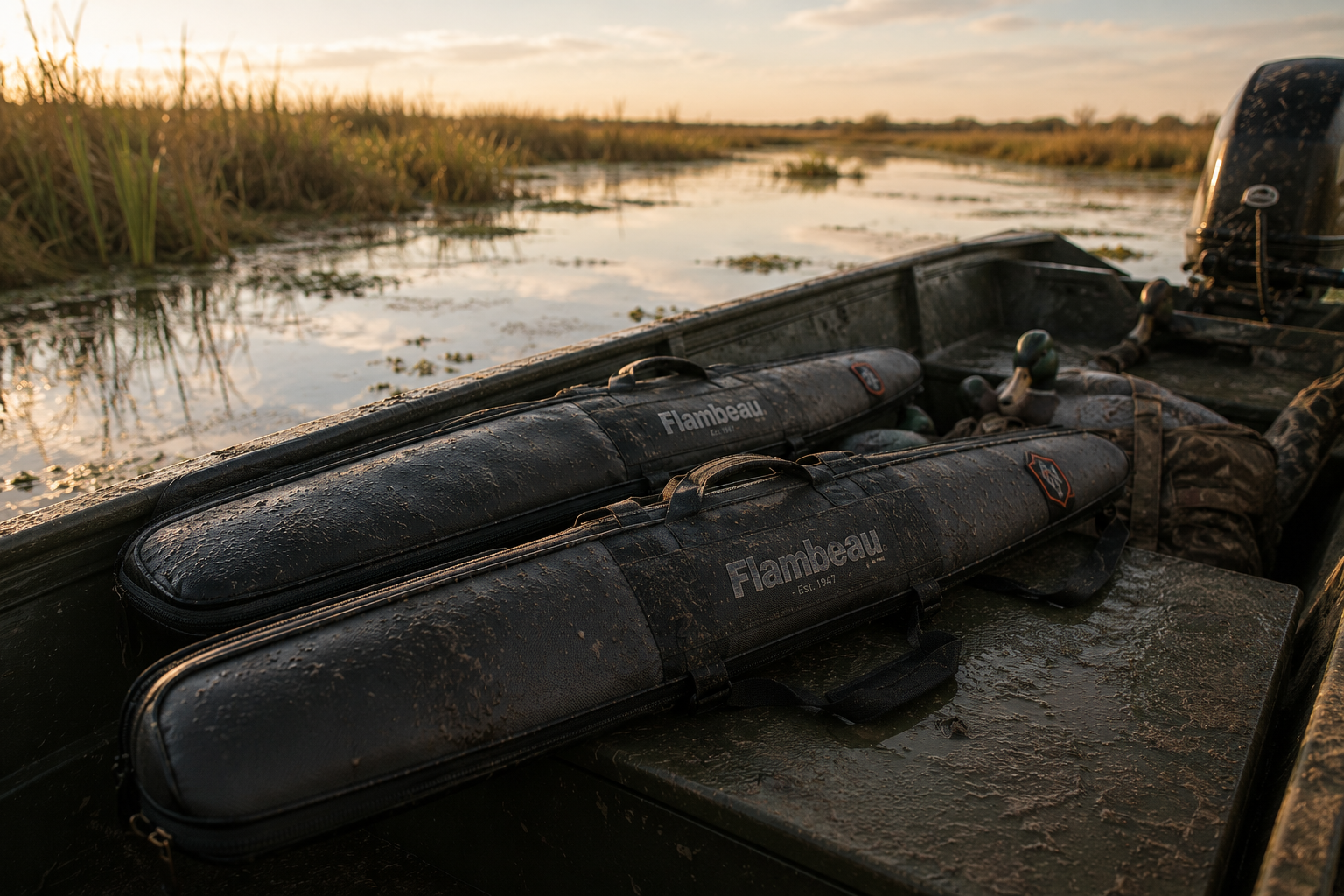
Duck hunting in the sprawling wetlands of Argentina is an incredibly gear-intensive pursuit. Transporting hunters, decoys, and firearms from the solid ground of the estancia to a remote bañado blind requires navigating deep mud, submerged obstacles, and open water in small aluminum skiffs. In this chaotic, wet environment, a full-service shotgun is highly vulnerable. To protect your investment and ensure your firearm functions reliably, a padded, floating gun case is an absolute necessity.
The Limitation of Airline Cases
Many traveling wingshooters assume they can simply use their TSA-approved travel case to transport their shotgun to the blind. This is a critical logistical error. Hard-sided, lockable airline cases are large, heavy, and completely impractical for field use. They take up too much valuable floor space in a small duck boat, and if a sudden shift in weight causes one to fall overboard, it will sink straight to the bottom of the marsh. Your heavy airline case should never leave the lodge.
The Advantages of the Floating Soft Case
For daily field deployments, you must pack a soft-sided, floating gun case inside your checked duffel bag. These specialized cases are constructed from heavy-duty, water-resistant fabrics and lined with closed-cell foam that serves two vital purposes:
- Impact and Debris Protection: The boat ride to the blind is rarely smooth. Your shotgun will be subjected to vibration, accidental kicks, and a constant spray of muddy water. A padded case absorbs these impacts and seals the firearm's action away from abrasive grit that can cause jamming in the blind.
- Buoyancy Insurance: Loading and unloading gear in the dark on a slippery, muddy bank is when accidents happen. If a shotgun slips from a hunter's grasp or slides off the gunwale of the skiff, the closed-cell foam guarantees the heavy firearm will stay afloat on the surface of the water, preventing a catastrophic loss.
- Space Efficiency: Soft cases can be easily folded or tucked out of the way under the boat's seats once you arrive at the blind and uncase your weapon, keeping the shooting area clear of tripping hazards.
The Estancia Protocol
experienced hunting operations understand the toll the marsh takes on equipment. While guides and hunting assistants handle the heavy lifting, it is the hunter's responsibility to bring the right protective gear for their personal or rental firearms. Bringing a dedicated floating case ensures that when the sun rises and the first flock of Rosy-billed Pochards commits to the decoys, your shotgun comes out of the case clean, dry, and ready to fire.
Skiff Dynamics: Shooting Ducks from an Aluminum Boat
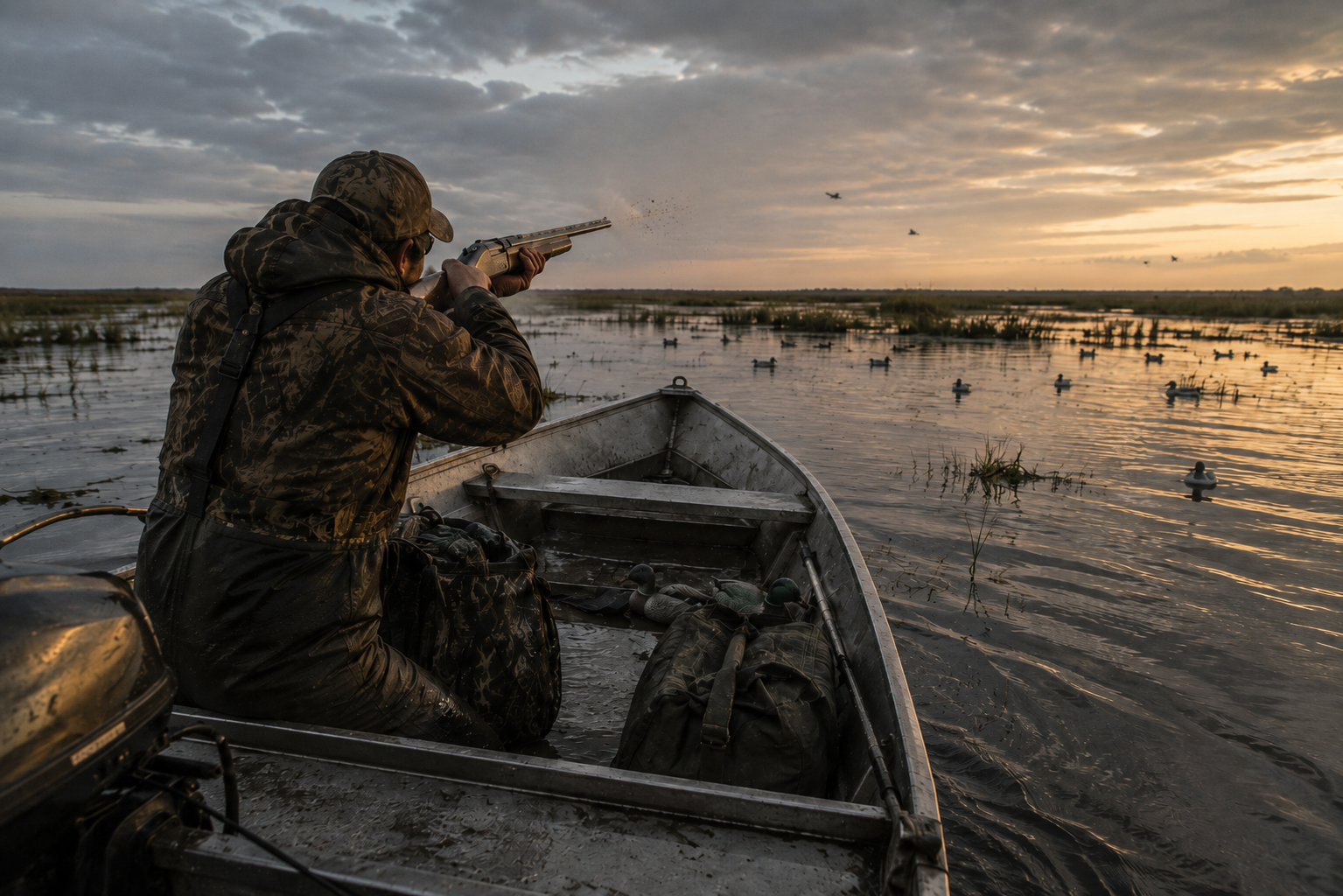
Duck hunting in the sprawling Argentine wetlands frequently requires deploying into the deep marsh via small, flat-bottomed aluminum skiffs. As a thrilling morning component of a broader mixed-bag itinerary, this fast-paced waterfowl action demands specific physical adjustments from the shooter. Firing a shotgun from a floating, dynamic platform introduces variables of balance, recoil, and spatial awareness that are entirely absent when standing on the solid ground of a dove roost or a walked perdiz field.
The Physics of the Skiff
An aluminum mud boat resting on shallow water is highly reactive. Every shift in your body weight, every sudden movement to mount the gun, and the heavy kinetic recoil of every shot fired translates directly into the hull, causing the skiff to pitch and roll. For a hunter accustomed to planting their feet firmly on dry land, this instability can severely disrupt a smooth swing and lead to missed birds.
Tactical Boat Mechanics
Shooting effectively from a skiff requires a conscious adjustment to your physical mechanics and strict adherence to spatial safety rules.
- Establishing the Base: Never stand abruptly to take a shot as a flock approaches. Shooting from a seated position or a low crouch keeps your center of gravity anchored and the boat stable. If the reeds are too high and you must stand, maintain a wide, athletic stance with your knees slightly bent to absorb the boat's lateral movement.
- Defining the Arc of Fire: When two hunters share a skiff, strict firing zones are non-negotiable. Establish an imaginary centerline dividing the decoy spread. You own your side, and your partner owns theirs. Never chase a fast-crossing bird across the centerline, as the shifting weight of two hunters suddenly leaning in the exact same direction can compromise the stability of a small vessel.
- Hull Management: Ejected plastic hulls rolling around on a wet aluminum floor act like ball bearings under muddy boots. Continually sweep empty shells into a designated blind bag or a corner to maintain a secure footing.
The Mixed-Bag Protocol
Related AWSORG Field Intelligence
- Duck Hunting in Argentina: Complete Guide
- Duck Calling in Argentina
- Duck Decoys, Blinds & Concealment in Argentina
- What to Pack for Duck Hunting in Argentina