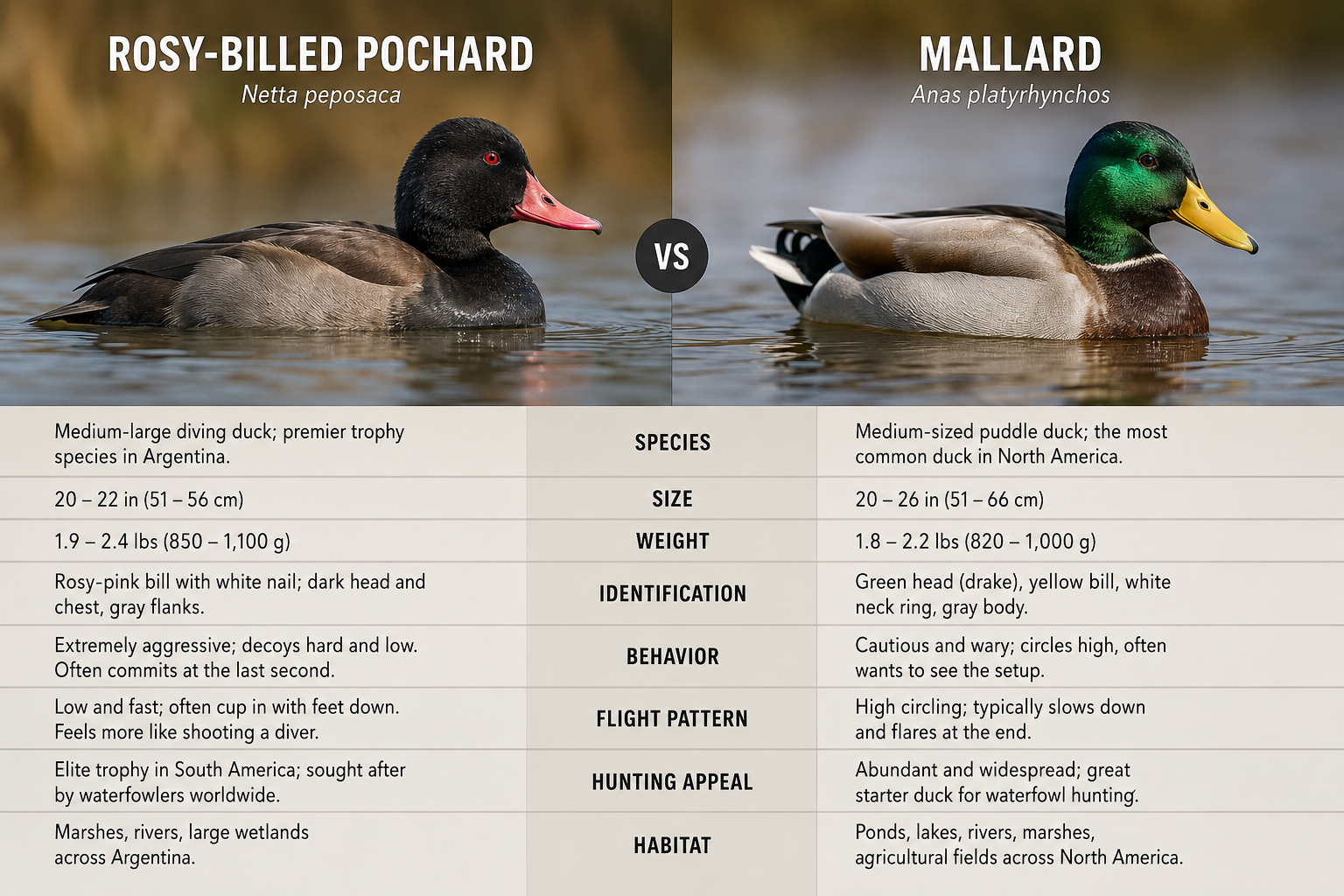
Argentina offers an incredibly diverse waterfowl ecosystem, with hunters typically encountering 8 to 12 different native duck species during a winter expedition, highlighted by the prized Rosy-billed Pochard, Silver Teal, and White-cheeked Pintail. Unlike North America, these species are entirely unique to the Southern Hemisphere, requiring hunters to quickly learn new flight patterns and plumage characteristics for proper in-blind identification.
The Core Argentine Waterfowl Bag
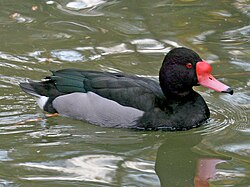
The crown jewel of the Argentine marsh is the Rosy-billed Pochard. These large, heavy-bodied divers migrate from Patagonia and are known for their spectacular, aggressive decoying behavior. Drakes feature a striking jet-black body with a bright crimson bill. Alongside the pochards, the pampas wetlands host an incredible variety of teal. The Silver Teal and Speckled Teal provide blistering fast, low-level action that challenges the most seasoned shotgunners, while the vocal Fulvous and White-faced Whistling Ducks add unique auditory and visual dynamics to the morning flight.
| Duck Species | Flight Behavior & Decoying | Size & Visual Profile | Peak Season |
|---|---|---|---|
| Rosy-billed Pochard | Decoys aggressively, low over water | Large, black body, bright red bill (drakes) | June - July |
| Silver Teal | Extremely fast, erratic flight | Small, blue/yellow bill, striking silver flanks | May - August |
| White-cheeked Pintail | Fast, graceful glides | Medium, brown with bright white cheeks | May - August |
| Fulvous Whistling Duck | Slow, vocal, flocking | Medium, long legs, distinct whistling call | May - June |
Protected and Prohibited Species
Outfitters and provincial wildlife authorities strictly monitor the daily bag composition to protect specific local populations. For instance, the Black-headed Duck, which utilizes a unique parasitic nesting strategy similar to a cuckoo, is strictly protected and cannot be legally harvested. Your professional guide will call the shots and identify incoming flocks before you are cleared to fire.
Hunting Whistling Ducks in Argentina: The Sirirí Guide
Hunting whistling ducks in Argentina introduces international waterfowlers to one of the most vocal, visually distinct, and highly rewarding waterfowl targets in South America, demanding precise calling techniques and heavy shot payloads to conquer over the winter wetlands.
The Long-Legged Architects of the Marsh
Known across the Southern Hemisphere as *Sirirís* due to the high-pitched, musical three-note whistling sequence they produce continuously in flight, whistling ducks belong to a distinct biological lineage that bridges the evolutionary gap between true ducks and small geese. In the primary wingshooting provinces of Buenos Aires and Entre Ríos, hunters target two main species: the **White-faced Whistling Duck** (instantly recognizable by its stark white face mask and black neck) and the **Fulvous Whistling Duck** (boasting a uniform tawny-cinnamon plumage). Both species travel in large, tightly packed flocks that move with slow, deliberate wingbeats, their long legs trailing visibly behind them in the morning air.
| Sirirí Species | Anatomical Identifiers | Behavioral Profile |
|---|---|---|
| White-Faced (Sirirí Pampa) | Stark white face mask, black crown/neck, barred flanks. | Cautious flyer; executes wide circles over decoys before committing. |
| Fulvous (Sirirí Colorado) | Rich uniform cinnamon body, black back, dark wings. | Aggressive feeder; drops straight into flooded rice fields and pastures. |
The Tactical Whistle and Blind Execution
Conquering the Sirirí requires a complete abandonment of traditional North American mallard calling strategies. Standard mallard hen quacks are entirely foreign to these birds and will cause them to flare instantly. Outfitter guides mimic their melodic whistling calls reliably using their natural voices or specialized, double-chambered brass whistles. Whistling ducks are highly social; when they hear the guide's response echoing across the marsh, the entire flock will lock their wings, tilt their bodies laterally, and slide into a slow, parachuting descent directly into the kill pocket, offering spectacular close-range shooting.
Hunting the Rosy-Billed Pochard: Argentina's Heavyweight Waterfowl
The Rosy-billed Pochard is the established king of South American waterfowling, a large, heavy-bodied diving duck that provides international sportsmen with spectacular, close-range decoying action across the unpressured winter marshes of Argentina.
The Heavyweight of the Flyway
For the traveling wingshooter, the Rosy-billed Pochard (*Netta peposaca*) is the complete prize of the morning marsh. Known locally as the *Rosao* due to the drake's spectacular, bulbous bright crimson bill, this species is structurally large—approaching the physical weight and size of a North American Canvasback. Despite belonging to the diving duck family, the Rosy-bill feeds heavily on agricultural seeds and aquatic vegetation in shallow water. They migrate northward from the sub-Antarctic lakes of Patagonia every winter, swarming the flooded pastures of Buenos Aires, Entre Ríos, and Santa Fe in large, tightly bunched flocks.
Species ProfileRosy-Billed Pochard (Netta peposaca)Visual Identification (Drake)Jet-black chest and head, purplish-sheen back, bulbous rosy-red bill.Flight ProfileAggressive, direct, low-altitude flights; capable of immense air speeds.Decoying SophisticationHighly visual; commits with absolute aggression to large spreads without circling.Ammunition MandateNon-toxic steel or bismuth ONLY; heavy payload required.
Conquering the Armored Target
Hunting the Rosy-bill requires a significant ballistic step up from the afternoon dove roost. Because these ducks migrate through extreme cold fronts, they develop an incredibly dense layer of insulating down and thick winter feathers that acts as a natural body shield. Firing light, low-velocity target loads will merely wound the bird, leading to frustrating lost game in the deep reeds. To secure clean, ethical harvests, you must utilize a 12-gauge shotgun loaded with high-velocity non-toxic steel shot in sizes #3 or #4, paired with a Light Modified choke to deliver devastating downrange energy as the birds back-pedal over the decoys.
Hunting the Silver Teal (Pato Capuchino)
While the Speckled Teal provides the sheer volume of the Argentine marsh, the Silver Teal (*Pato Capuchino*) offers international waterfowlers a uniquely beautiful, highly responsive target that demands rapid shotgun mechanics over the decoy spread.
The Profile of the Pato Capuchino
Known locally across the pampas as the *Pato Capuchino* (due to its distinct dark hood or "cap"), the Silver Teal (*Spatula versicolor*) is a visually striking puddle duck. The drake is easily identified by the stark contrast between its dark brown, almost black, upper half of the head, and its pale, cream-colored lower face and throat. Its flanks are heavily barred with black and white, and it features a brilliant green-and-white speculum on the wing. Like all South American teal, they are aerodynamically built for blistering speed, but they tend to fly in slightly smaller, tighter groups than their Speckled cousins, often buzzing the edges of the reed beds in the deep river sloughs of Santa Fe and Corrientes.
| Species Profile | Silver Teal (Pato Capuchino) |
|---|---|
| Visual Identification | Dark brown "cap" on the head; pale lower face; striking blue/yellow bill. |
| Habitat Preference | Deep river edges, reedy sloughs, and temporary agricultural lagoons. |
| Flight Mechanics | Blistering speed; low-level skimming; highly synchronized banking. |
| Decoying Behavior | Highly responsive to acoustic whistling; will make multiple rapid passes before landing. |
Decoying the Silver Teal
Hunting the Silver Teal is an exercise in acoustic manipulation. They are incredibly vocal birds, communicating in flight with sharp, continuous clicking trills and high-pitched whistles. Because they fly so fast, they often pass completely over the decoy spread before they decide to commit. Your guide will deploy a specialized brass teal whistle, executing rapid, staccato bursts. The Silver Teal will hear the call, bank violently in mid-air, and execute a high-speed strafing run back across the landing pocket. They do not hover or drop slowly; they dive into the water with absolute aggression. You must maintain an aggressive, sustained forward lead. A 20-gauge loaded with #5 non-toxic steel shot is the optimal payload for cutting through their dense winter down without destroying the meat.
Hunting the White-Cheeked Pintail
The White-cheeked Pintail (Anas bahamensis)—frequently referred to as the Bahama Pintail—is one of the most elegant and sought-after puddle ducks in South America, offering wingshooters spectacular decoying action across the shallow coastal wetlands and agricultural lagoons of Buenos Aires Province.
The Striking Profile of the White-Cheek
For international waterfowlers, the White-cheeked Pintail is a true bucket-list trophy. Instantly recognizable by its chocolate-brown crown, stark white cheeks and throat, and a brilliant carmine-red patch at the base of its slate-grey bill, both the drake and the hen share this identical, vibrant plumage. They are medium-sized, highly agile dabbling ducks that travel in small, disciplined flocks. Unlike heavy divers that crash blindly into the decoys, White-cheeked Pintails are notoriously cautious; they will circle a spread multiple times at high altitudes, analyzing the parameters of the marsh before dropping their landing gear.
| Species Profile | White-Cheeked Pintail (Bahama Pintail) |
|---|---|
| Visual Identification | Stark white cheeks/throat, chocolate crown, red bill patch (both sexes). |
| Habitat Preference | Shallow freshwater lagoons, brackish marshes, and flooded grain fields. |
| Flight Mechanics | Graceful and rapid; executes sharp, sweeping turns over timber. |
| Decoying Behavior | Wary; requires strict blind concealment and precise wind alignment. |
Tactical Blinds and Decoying
Because White-cheeked Pintails possess exceptional eyesight, hunting them requires strict blind discipline. full-service outfitters position sunken dry blinds or heavily brushed hides along the shallow edges of permanent lagoons where the birds naturally tip-up to feed on seeds and aquatic invertebrates. They respond exceptionally well to mixed puddle duck spreads, frequently flying alongside Yellow-billed Pintails and Teal. Firing a modern 12-gauge or 20-gauge semi-automatic loaded with non-toxic steel shot in sizes #4 or #5 through a Light Modified choke provides the perfect, forgiving pattern to secure clean, ethical harvests without destroying their prized trophy feathers.
Hunting the Speckled Teal (Pato Barcino)
The Speckled Teal (*Pato Barcino*) forms the ubiquitous, high-speed backbone of the Argentine winter waterfowl harvest, providing international hunters with blistering, unpredictable swarms that test the limits of shotgun tracking and reactionary speed.
The Agile Engine of the Marsh
If the Rosy-billed Pochard is the heavy bomber of the Argentine marsh, the Speckled Teal (*Anas flavirostris*) is the fighter jet. It is one of the most abundant and frequently harvested puddle ducks in South America. The Speckled Teal is physically compact, featuring a distinct, dark-speckled breast and a bright yellow bill tipped in black. What they lack in large physical size, they make up for in sheer aerodynamic violence. They travel in tight, heavily synchronized flocks—often numbering 20 to 50 birds—that skim just inches above the marsh reeds at blistering speeds before executing perfectly coordinated, 90-degree vertical climbs over the decoy spread.
| Species Profile | Speckled Teal (Pato Barcino) |
|---|---|
| Visual Identification | Yellow bill with black tip; heavily speckled brown/grey breast. |
| Flight Mechanics | Blistering speed; low-altitude skimming; violent, synchronized flock turns. |
| Habitat Preference | Ubiquitous; thrives in both shallow flooded pastures and deep river edges. |
| Decoying Behavior | Aggressive, but erratic; frequently buzzes the spread multiple times before committing. |
Conquering the Swarm
Hunting the Speckled Teal is an exercise in managing sensory overload. When a flock of 40 teal suddenly drops into the kill pocket, the visual chaos causes many hunters to simply point their gun at the center of the mass and pull the trigger. This 'flock shooting' inevitably results in a clean miss, as the shot string passes harmlessly through the gaps between the tiny birds. You must exercise extreme ocular discipline. Force your eye to lock onto a single, specific bird—typically the leading drake at the edge of the formation. Execute a short, fast swing, shoot the target, and immediately acquire the next single bird as the flock violently flares upward.
Hunting the Southern Wigeon (Pato Overo)
The Southern Wigeon, known locally across the Argentine pampas as the *Pato Overo*, is a highly prized, elegant puddle duck that provides international waterfowlers with spectacular, vocal decoying action during the peak of the winter mixed-bag season.
The Whistling Aeronaut
For North American hunters accustomed to the American Wigeon (Baldpate), the Southern Wigeon (*Mareca sibilatrix*) offers a familiar but distinctly South American experience. Both the drake and the hen share an identical, striking plumage: a dark metallic green-black head featuring a stark white forehead and cheeks, paired with rust-colored flanks. They are medium-sized dabbling ducks that frequent the shallow, rain-fed agricultural lagoons of Buenos Aires and the edges of the deep river deltas. Like their northern cousins, Southern Wigeons are highly vocal and incredibly agile, capable of dropping altitude rapidly to slip into tight landing pockets.
| Species Profile | Southern Wigeon (Pato Overo) |
|---|---|
| Visual Identification | White forehead and cheeks; dark metallic head; rust-colored flanks. |
| Vocalization | A sharp, high-pitched, three-note whistle emitted continuously in flight. |
| Habitat Preference | Shallow flooded pastures, quiet lagoons, and marsh edges. |
| Decoying Behavior | Cautious but responsive; circles widely before committing to the wind. |
Tactical Execution over Shallow Water
Southern Wigeons are highly social and frequently mix with flocks of Yellow-billed Pintails and Speckled Teal. When targeting them, guides rely heavily on acoustics. Because they are "whistling" ducks (by vocalization, not by taxonomy like the Sirirí), your guide will utilize a specialized high-pitched whistle rather than a standard mallard call. When the flock hears the whistle, they will typically execute two to three wide reconnaissance circles over the spread. You must remain absolutely motionless. When they finally commit, they back-pedal aggressively, exposing their rust-colored flanks. Firing a 12-gauge or 20-gauge loaded with #4 non-toxic steel shot through an Improved Cylinder (IC) choke provides the perfect lethality for these 25-yard engagements.
Hunting the Brazilian Teal
The Brazilian Teal (Amazonetta brasiliensis) is a vibrant, highly sought-after South American puddle duck, providing international hunters with challenging, close-range decoying action in the shallow swamps and northern river deltas of Corrientes and Entre Ríos.
The Red-Legged Acrobat
Despite its name, the Brazilian Teal is highly abundant in the northern provinces of Argentina. It is a visually striking bird; the drakes feature bright red legs, a brilliant crimson bill, and a spectacular iridescent green and purple wing speculum that contrasts against a pale brown body. Unlike the large flocks of Silver Teal that swarm the central pampas, the Brazilian Teal prefers heavily vegetated swamps, slow-moving streams, and the edges of the Paraná River Delta. They typically fly in pairs or small flocks of up to six birds, relying on agility to weave through standing timber and tall reeds.
| Species Profile | Brazilian Teal (Amazonetta brasiliensis) |
|---|---|
| Visual Identification | Drake has a red bill and red legs; iridescent green/purple speculum. |
| Habitat Preference | Swamps, wooded river margins, and dense marsh vegetation. |
| Flight Mechanics | Highly agile, low-flying, capable of navigating thick cover. |
| Decoying Behavior | Responds well to small, intimate decoy spreads and soft whistling. |
Blind Setup and Targeting
Because they inhabit thicker, more complex environments, hunting Brazilian Teal is an intimate, close-quarters affair. Guides do not rely on 100-decoy open-water spreads. Instead, they position small clusters of decoys in tight, sheltered coves. When Brazilian Teal commit, they approach low over the vegetation and drop into the pocket rapidly. Hunters must maintain absolute stillness, as the birds will flare at the slightest movement in the blind. A 12-gauge or 20-gauge loaded with #4 or #5 non-toxic steel, paired with an open Improved Cylinder choke, is optimal for securing ethical kills without destroying the delicate red legs and bill prized for taxidermy.
Hunting the Red Shoveler
The Red Shoveler (Spatula platalea) is one of the most visually distinctive and sought-after puddle ducks in Argentina, prized by international collectors for its large, spatulate bill, rich cinnamon-red plumage, and aggressive decoying behavior in the shallow wetlands of Buenos Aires Province.
The Unique Profile of the Red Shoveler
For North American hunters accustomed to the Northern Shoveler, the South American Red Shoveler presents a familiar silhouette but a radically different color palette. The drake is spectacular, featuring a pale head, a heavily spotted cinnamon-red breast, and a large black bill designed to filter crustaceans and seeds from shallow mudflats. In flight, they reveal a striking pale blue patch on the forewing, making them easy to identify as they circle a decoy spread. Because they rely on sifting shallow water for food, they are rarely found in the deep, fast-moving river sloughs of the Paraná Delta, preferring the temporary flooded agricultural pastures of the Humid Pampa.
| Species Profile | Red Shoveler (Spatula platalea) |
|---|---|
| Visual Identification | large spoon-shaped bill; cinnamon-red spotted body; pale blue wing patch. |
| Habitat Preference | Shallow lagoons, flooded pastures, and muddy shorelines. |
| Flight Mechanics | Steady, direct flight; tightly bunched flocks. |
| Decoying Behavior | Highly responsive to large puddle duck spreads; commits aggressively. |
Blind Setup and Decoying Tactics
Hunting the Red Shoveler requires a classic puddle duck strategy. full-service outfitters in Buenos Aires set their blinds on the edges of shallow, muddy lagoons, deploying large spreads of mixed puddle duck decoys. Shovelers are not particularly call-shy, but they are highly visual. They frequently decoy alongside White-cheeked Pintails and Yellow-billed Pintails. When they commit, they lock their wings and glide directly into the pocket, offering excellent, close-range decoying action. A standard 12-gauge loaded with #4 non-toxic steel shot and a Light Modified choke is the perfect configuration to harvest them cleanly for the taxidermist.
Hunting the Cinnamon Teal
The Cinnamon Teal (Spatula cyanoptera) is a visually striking, highly agile dabbling duck that provides international waterfowlers in Argentina with exceptional close-range decoying action, often mixing seamlessly into flocks of Silver and Speckled Teal across the shallow flooded pastures of the Humid Pampa.
The Crimson Acrobat
For the North American hunter, the Cinnamon Teal is a prized, somewhat elusive target typically found only in the western flyways. In Argentina, they are highly abundant. The drake is unmistakable in the morning sun, boasting a rich, deep mahogany-red body, a brilliant red eye, and a striking pale blue patch on the forewing that flashes brightly as they bank into the decoys. Like all South American teal species, they are built for speed and agility. They fly in tight, synchronized flocks that skim just inches above the marsh grass, making sudden, erratic vertical drops directly into the landing pocket.
| Species Profile | Cinnamon Teal (Spatula cyanoptera) |
|---|---|
| Visual Identification | Deep mahogany-red body (drake), bright red eye, pale blue wing patch. |
| Habitat Preference | Shallow lagoons, flooded agricultural pastures, and reedy shorelines. |
| Flight Mechanics | Blindingly fast; erratic, synchronized flock movements. |
| Decoying Behavior | Highly aggressive; responds instantly to puddle duck spreads and whistles. |
Blind Tactics for the Cinnamon Teal
Hunting Cinnamon Teal is a fast-twitch exercise. Because they share the exact same shallow-water habitat as the Silver Teal and the White-cheeked Pintail, you do not need a species-specific decoy spread. A large, mixed puddle duck spread is highly effective. The tactical challenge is target acquisition. Cinnamon Teal frequently fly beneath the horizon line, using the reeds as cover. You must keep your head down and rely on your guide's call. When they clear the reeds, they decelerate incredibly fast, meaning a hunter who swings too fast and shoots with an open choke will frequently shoot in front of the bird.
Hunting the Yellow-Billed Pintail (Pato Maicero)
The Yellow-billed Pintail (Pato Maicero) is one of the most prolific and highly sporting puddle ducks in Argentina, providing international hunters with classic, agile decoying action across the vast, shallow wetlands and flooded agricultural pastures of the Humid Pampa.
The South American Standard
Known locally as the *Pato Maicero* (Corn Duck) due to its heavy reliance on agricultural grain, the Yellow-billed Pintail (*Anas georgica*) is a staple of the Argentine mixed-bag. While it lacks the striking, colorful plumage of the Rosy-billed Pochard or the Cinnamon Teal, it makes up for it in sheer volume and sporting quality. To the North American hunter, it closely resembles a hen Northern Pintail—featuring a mottled brown body and an elongated, pointed tail—but is instantly distinguished by its bright yellow bill featuring a black stripe down the center. Both the drake and the hen share this identical plumage.
| Species Profile | Yellow-Billed Pintail (Pato Maicero) |
|---|---|
| Visual Identification | Mottled brown body, pointed tail, bright yellow bill with black center stripe. |
| Habitat Preference | Shallow flooded pastures, lagoons, and agricultural edges. |
| Flight Mechanics | Agile, graceful, capable of sharp vertical descents into decoys. |
| Decoying Behavior | Highly responsive to standard puddle duck spreads and whistles. |
Decoying the Pato Maicero
Hunting the Yellow-billed Pintail requires textbook puddle duck tactics. They do not dive into deep river sloughs; they prefer water that is inches deep where they can tip-up to feed on submerged seeds and invertebrates. Outfitters in Buenos Aires Province and Entre Ríos heavily target this species by placing dry-blinds directly on the edges of flooded alfalfa or corn fields. Because they are highly social, they mix freely with White-cheeked Pintails and Teal. They circle decoy spreads cautiously, evaluating the landing pocket before executing a steep, back-pedaling descent, offering perfect 20-yard shots for hunters utilizing #4 or #5 non-toxic steel.
Hunting the Sirirí: Argentina's Whistling Ducks
For North American waterfowlers accustomed to the silent, stealthy approach of late-season mallards, intercepting a large flock of Argentine Whistling Ducks (the *Sirirí*) is a spectacular, acoustically overwhelming experience that defines the South American marsh.
The Anatomy of the Sirirí
Argentina is home to two primary species of Whistling Duck: the **Fulvous Whistling Duck** (*Sirirí Colorado*) and the **White-Faced Whistling Duck** (*Sirirí Pampa*). Taxonomically, they bridge the biological gap between ducks and geese. They are characterized by long, elegant necks, broad rounded wings, and unusually long legs that trail visibly behind their bodies during flight. Because of their large wingspan-to-weight ratio, they do not execute the blistering, erratic dives of a Speckled Teal. Instead, they fly with a slow, rhythmic, almost butterfly-like wingbeat. They travel in large, highly social flocks, often numbering in the hundreds, and they are incredibly vocal, emitting a continuous, shrill, multi-syllable whistle as they transit the marsh.
| Species Profile | Fulvous Whistling Duck (Colorado) | White-Faced Whistling Duck (Pampa) |
|---|---|---|
| Visual Identification | Rich, uniform rust/cinnamon body; dark stripe down the back of the neck. | Stark white face mask; dark black head and neck; barred black-and-white flanks. |
| Habitat Preference | Deep river sloughs and dense, flooded rice fields. | Shallow agricultural lagoons and temporary pasture bogs. |
| Flight Mechanics | Slow, rhythmic wingbeats; long legs trailing visibly behind the tail. | Slow, rhythmic wingbeats; highly synchronized flock movements. |
The Acoustic Decoying Strategy
Because the *Sirirí* is highly social and exceptionally vocal, the decoying strategy relies heavily on acoustic mimicking. Your Argentine guide will completely ignore the motorized spinning-wing decoys (which whistling ducks often view with suspicion) and focus entirely on calling. Using either a specialized brass whistle or their own natural voice, the guide will perfectly mimic the shrill, cascading trill of the flock. When the birds commit, they do not drop like stones; they execute a slow, majestic, hovering descent into the landing pocket. Because they are hovering slowly with their long legs dangling, hunters often misjudge their speed and shoot in front of them. You must shorten your forward lead and aim directly for the bird's extended neck. A 12-gauge loaded with #4 non-toxic steel shot provides perfect lethal coverage for these large, hovering targets.
Related AWSORG Field Intelligence
- Duck Hunting in Argentina: Complete Guide
- Argentina Duck Hunting Limits & Regulations by Province
- Argentina Duck Hunting Regions: Buenos Aires, Entre Ríos and the Paraná
- Boats, Transfers & Safety in Argentina Duck Marshes
Field Visuals