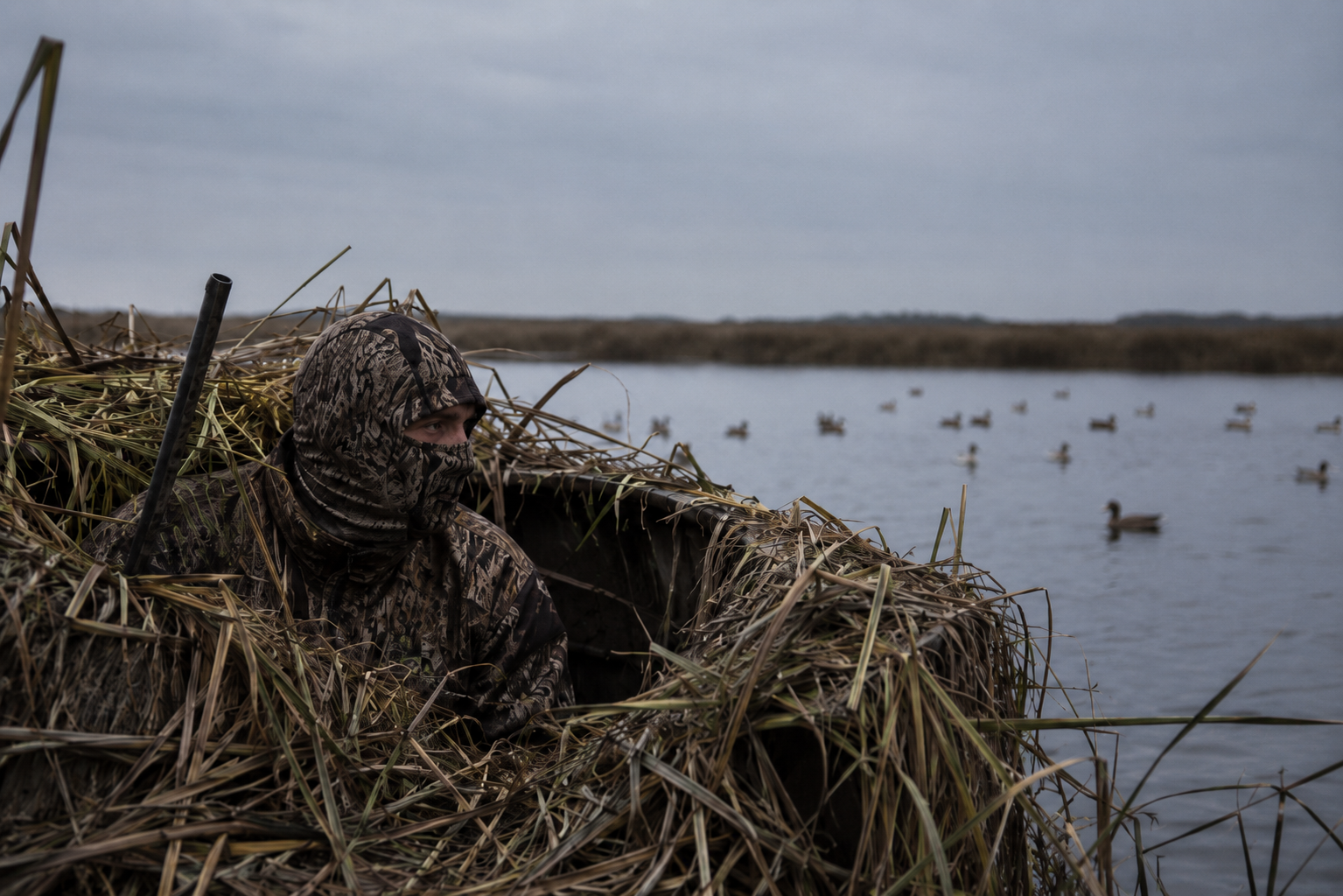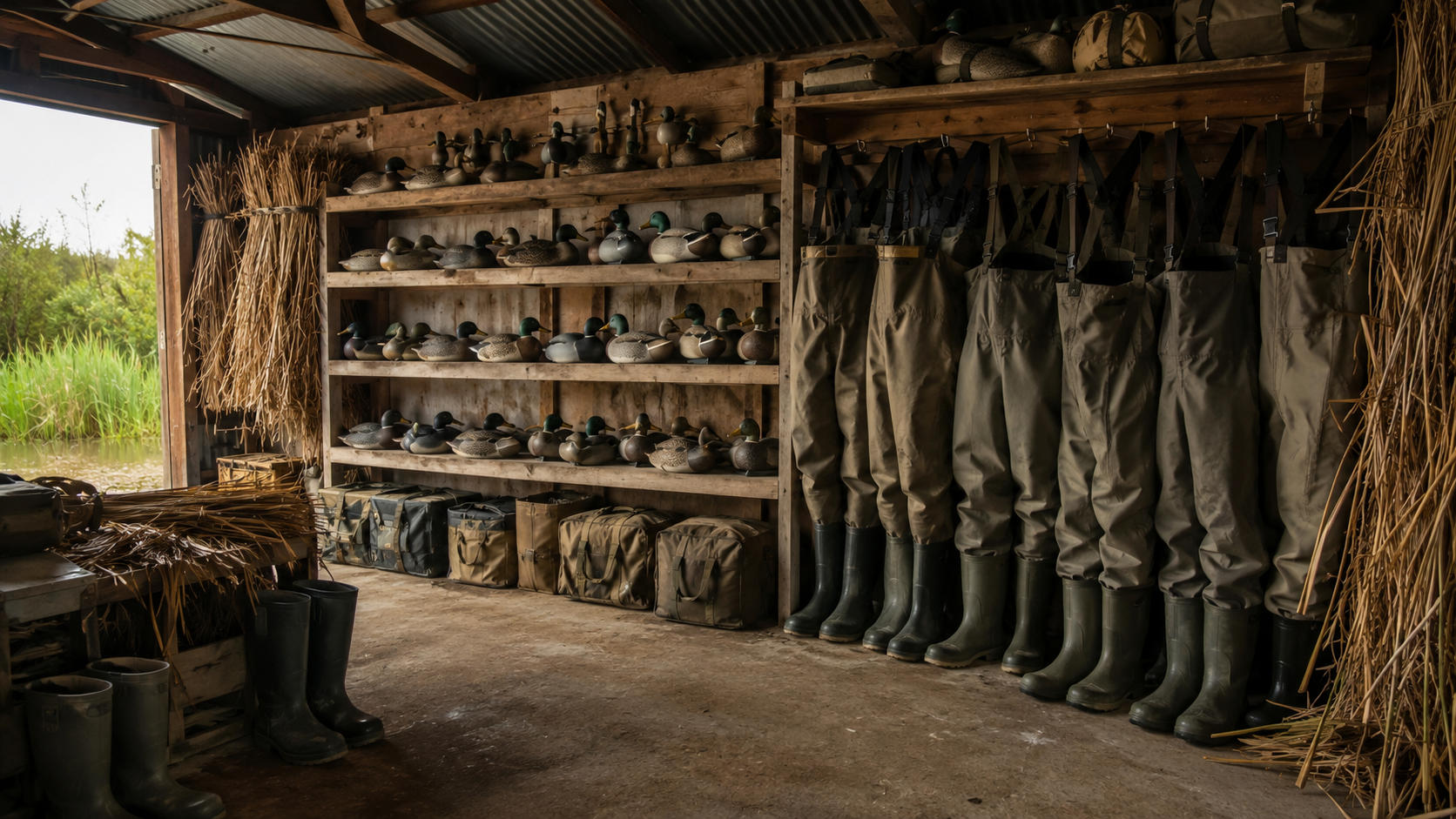
The infrastructure of a full-service Argentina duck hunt completely shifts the physical burden away from the international hunter, utilizing professional guides to manage large decoy spreads, pilot specialized mud boats, and prepare custom-built blinds, allowing sportsmen to focus entirely on shooting.
The Full-Service Marsh
In North America, waterfowlers are accustomed to the grueling DIY grind: waking up at 2:00 AM, hauling 50-pound bags of decoys through freezing mud, and brushing their own blinds. In Argentina, the "full-service" estancia model eliminates this friction. While you are drinking coffee in the lodge dining room, the outfitter's field staff has already deployed into the marsh. They utilize local knowledge to set 50 to 100-piece decoy spreads precisely aligned with the morning's wind direction. When you arrive at the water's edge, you simply step into a pre-brushed, fully camouflaged blind.
| Marsh Infrastructure | How Outfitters Manage It | Advantage for the Hunter |
|---|---|---|
| Decoy Spreads | Guides deploy 50+ shells and motion decoys before dawn. | Zero physical labor; spreads are perfectly tuned to the wind. |
| Blind Construction | Pre-built sunken dry-blinds or brushed boat hides. | Maximum concealment and wind protection; comfortable seating. |
| Marsh Navigation | Specialized flat-bottom mud boats or 4x4 trucks. | Safe, effortless transit through deep sloughs and sticky mud. |
| Bird Retrieval | Guides and trained retrievers collect all downed ducks. | Hunters never have to leave the blind to chase crippled birds. |
The Wader Rental Advantage
The physical environment dictates your gear. In the deep river sloughs of Santa Fe, you will hunt from boat blinds or stand in waist-deep water. In Buenos Aires, you may hunt from sunken "dry" blinds surrounded by shallow flooded pastures. The most critical logistical decision you will make is regarding waders. Packing heavy, 5mm neoprene chest waders eats up large amounts of your 15kg domestic airline weight limit. full-service lodges have solved this by offering extensive rental fleets of high-quality, sanitized breathable waders and boots. Renting your waders on-site is the smartest tactical move an international hunter can make.
Duck Hunting Decoys, Blinds, and Waders
Deploying into the freezing wetlands of Argentina requires international waterfowlers to understand the tactical intersection of large decoy spreads, heavily camouflaged natural blinds, and the absolute necessity of full-service 5mm neoprene chest waders to survive the deep river sloughs.
The Architecture of the Argentine Blind
In Argentina, you will rarely encounter the large, heated permanent box blinds common in the United States. Because water levels fluctuate violently between wet and dry years (El Niño vs. La Niña), outfitter guides must remain mobile. In the shallow pastures of Buenos Aires, guides dig "dry blinds"—sunken bucket-style pits on the edges of flooded alfalfa, brushed over with local pampas grass. In the deep river deltas of Santa Fe, the blind is often the mud boat itself, draped in military-grade netting and driven directly into dense reed beds, or a temporary wooden platform built overnight on a tidal mudflat.
Waterfowl GearTactical Application in ArgentinaHunter RecommendationDecoy SpreadsMassive volume (50-100 blocks) to mimic large, unpressured migrations.Supplied entirely by the outfitter; you do not pack decoys.Motion SpinnersMotorized Mojos pull high-flying Pochards down into the pocket.Supplied by outfitter; highly effective on naive South American birds.Chest WadersMandatory for warmth and safety in deep delta mud.Rent from the lodge to save 10 lbs of luggage weight.Blind BagsWaterproof roll-top bag to protect ammunition and electronics.Must bring your own; pack strictly essential items only.
The Wader Mandate
If you are hunting the Paraná Delta, you must wear full-service insulated chest waders. Even if you are hunting from a dry platform blind, the boat ride to the blind is freezing, and the mud surrounding the blind is incredibly deep. A misstep in knee boots will fill your boots with freezing water, instantly inducing hypothermia and ruining the hunt. 5mm neoprene waders with 1000-gram Thinsulate boots provide the core insulation necessary to survive 35°F mornings. Because waders are massively heavy and trigger airline baggage weight limits, experienced estancias maintain vast fleets of sanitized rental waders in all sizes.
Decoying vs Pass Shooting Ducks
Waterfowl hunting in Argentina is overwhelmingly dominated by highly tactical, close-range decoying over large artificial spreads; opportunistic pass shooting is generally reserved only for days with extreme, gale-force winds or late-season hunts targeting highly educated birds.
The Dominance of the Decoy
In heavily pressured public lands in the United States, ducks often become "decoy shy," forcing hunters to rely on long-range pass shooting as birds skirt the edges of the marsh. In Argentina, the exact opposite is true. The winter migration from Patagonia brings millions of Rosy-billed Pochards and Teal into the unpressured wetlands of Buenos Aires and Santa Fe. Because these birds have not been shot at constantly, they commit to landing zones with extreme aggression. full-service outfitters capitalize on this naivety, deploying 50 to 100 full-body shells and motorized spinners to pull the flocks directly into a 20-yard "kill pocket," resulting in spectacular, feet-down shooting.
Hunting TacticCharacteristics in ArgentinaHunter ExecutionDecoying (Primary Strategy)Birds drop altitude, cup wings, and commit to the spread.Requires absolute stillness in the blind until the guide calls the shot.Pass Shooting (Secondary)Birds transit overhead between roosts and feeding zones.Requires heavy sustained leads and tighter shotgun chokes.
When Pass Shooting Occurs
While guides actively try to avoid pass shooting (as it leads to crippled birds and difficult retrieves in deep mud), environmental factors sometimes force their hand. During the late season (August), the surviving ducks become educated and wary, often circling wide and refusing to commit to the final landing approach. Furthermore, if a large Antarctic cold front hits the pampas generating 30+ mph winds, the birds will fly erratically and struggle to land accurately. In these scenarios, hunters must adapt, tightening their chokes to Modified or Improved Modified and taking 40-yard passing shots on crossing flocks.
Waterfowl Decoys in Argentina: Floaters, Full-Bodies, and Spinners
Convincing cautious, high-flying South American waterfowl to drop their landing gear into a specific 20-yard kill zone requires Argentine guides to deploy large, highly engineered decoy spreads that combine traditional floating blocks with aggressive, motorized wing-spinners.
The Scale of the Spread
Because the large river deltas of Santa Fe and Entre Ríos act as superhighways for millions of migrating ducks, a small, subtle decoy spread of a dozen birds is completely ineffective. You are competing against thousands of live ducks rafted up in adjacent lagoons. full-service outfitters engineer large visual footprints. Guides typically deploy between 50 and 100 oversized floating decoys. Because species like the Rosy-billed Pochard and Yellow-billed Pintail are highly visual, the guides group the blocks by species, creating distinct "landing runways" (the 'U' or 'J' hook formation) that funnel the incoming birds directly into the wind and right over the center of the blind.
| Decoy Type | Tactical Application in the Marsh | Target Impact |
|---|---|---|
| Oversized Floaters | Mass volume; deployed in deep water and river sloughs. | Creates the necessary visual footprint to pull high-altitude flocks. |
| Full-Body Shells | Placed on the muddy banks or edges of dry pasture pits. | Adds realism; mimics ducks resting or feeding on the shore. |
| Motorized Spinners (Mojos) | Placed on tall stakes directly in the landing pocket. | The flashing wing motion hypnotizes aggressive diving ducks. |
| Jerk Cords | Manual lines pulled by the guide to create water ripples. | Breaks the surface tension on dead-calm mornings to simulate live movement. |
The Lethality of the Spinner
Decoy Spread Strategies for Argentina Duck Hunting
Executing a successful waterfowl hunt in the Argentine pampas relies on large, meticulously structured decoy spreads—often deploying 50 to 100 blocks in aggressive "U" or "J" formations—designed to mimic relaxed, feeding flocks while forcing migrating Pochards and Teal into a perfectly engineered landing pocket.
The Geometry of the Pampas Spread
Because Argentine ducks experience virtually zero hunting pressure on their migration northward from Patagonia, they are highly visually oriented and commit aggressively to large spreads. However, local guides do not simply throw decoys randomly into the marsh. They construct the spread based entirely on wind direction. The classic "U" shape is the most dominant tactic. The blind forms the base of the "U," with two long lines of decoys extending out into the water, creating a completely empty runway in the center. Because ducks must land facing the wind, they fly up the runway and stall directly in front of the guns.
| Spread Element | Tactical Function | Placement Details |
|---|---|---|
| The Landing Pocket (Kill Zone) | Forces birds to brake and hover within ethical shotgun range. | 15 to 25 yards directly downwind of the primary blind. |
| Species Separation | Mimics natural biological flocking behavior. | Pochards grouped in deeper water; Teal grouped tightly in the shallows. |
| Motion Decoys (Spinners/Pulsators) | Draws attention from high-altitude migrating flocks. | Placed at the top of the landing pocket to act as a focal point. |
| The 'Confidence' Decoys | Reassures wary birds that the area is safe. | Heron, Egret, or Southern Screamer decoys placed on the marsh edges. |
Managing Species-Specific Landing Zones
A true Argentine mixed marsh holds multiple species simultaneously, meaning the decoy spread must cater to different biological habits. The Rosy-billed Pochard, which behaves like a diver duck, prefers to land in open water and swim into the feed. Guides will set the large Pochard blocks on the outer edges of the "U." Conversely, Silver Teal and Speckled Teal are dabblers that prefer shallow mudflats; their decoys are clustered tightly near the reeds and the shoreline. This separation prevents the spread from looking like a chaotic, unnatural jumble.
Decoy Geometry: The J-Hook vs U-Spread
Manipulating the flight paths of South American waterfowl requires Argentine field guides to act as aerodynamic engineers, utilizing precise geometric decoy formations—specifically the J-Hook and the U-Spread—to funnel ducks directly into the blind's firing arc.
The Aerodynamics of the Landing Pocket
Ducks are biological aircraft. They must take off and land facing directly into the wind to generate lift and braking drag. If a guide throws 100 decoys into a lagoon randomly, a flock of Yellow-billed Pintails will simply land on the outer edges of the group, 60 yards away from the hunters. To force the birds into lethal 20-yard range, the guide must create an empty runway (the landing pocket) within the decoy mass. The decoys act as physical barriers. Because ducks will not land directly on top of other ducks, they will automatically target the open water channel that the guide has intentionally left empty right in front of the blind.
| Decoy Geometry | Visual Structure | Tactical Application |
|---|---|---|
| The "U" Spread | Decoys form a large "U" shape, with the blind at the bottom center. | Best for direct, straight-on winds; funnels birds straight at the hunters. |
| The "J" Hook | A long line extending downwind, curving sharply back toward the blind. | The experienced Standard. Perfect for crosswinds; forces birds to fly up the long line and bank into the pocket. |
| The Split (X-Spread) | Two large groups of decoys with a wide channel down the middle. | Utilized in deep-river boat blinds to simulate two distinct resting rafts of diving ducks. |
Deploying the J-Hook in the Pampas
The J-Hook is the absolute masterstroke of the Argentine duck marsh. It is particularly effective for large diving ducks like the Rosy-billed Pochard. If the wind is blowing from left to right across the blind, the guide will trail a long, straight line of decoys extending far out to the right (downwind). This is the "tail" of the J. It acts as a large visual runway. As a flock approaches, they lock onto this long line and follow it upwind. As they reach the end of the line (directly in front of the blind), the guide creates a thick, blocking "hook" of decoys. The ducks hit this visual wall, brake hard, cup their wings, and hang suspended in the air at 15 yards, presenting the complete decoying shot.
Mojo Decoys: Deploying Spinning Wings in the Argentine Marsh
Manipulating the flight paths of South American waterfowl requires dynamic visual attractants; the deployment of motorized spinning-wing decoys (universally referred to as "Mojos") is the absolute anchor of the Argentine decoy spread, provided the guide understands seasonal avian psychology.
The Visual Flash of the Spinner
Ducks possess exceptional visual acuity, specifically tuned to detect the rapid, contrasting strobe effect of bird wings flapping as they land on the water. In the vast, flat Bañados of Buenos Aires, a static spread of 50 floating decoys can easily go unnoticed by high-flying flocks of Speckled Teal. The spinning-wing decoy serves as the long-range visual lighthouse. The rapid rotation of the black-and-white wings creates a strobe effect visible for miles across the pampas. Once the flock identifies the flash, they break altitude and lock onto the spread. The guide will almost exclusively place the spinner directly inside the open "landing pocket" (the center of the U-Spread or the leading of the J-Hook), giving the ducks a precise, physical target to aim at as they cup their wings.
| Waterfowl Species | Response to Spinning-Wing Decoys | Guide's Tactical Execution |
|---|---|---|
| Speckled & Silver Teal | Highly Aggressive. Dive bombs the spinner. | Leave the spinner running constantly; place it 15 yards from the blind. |
| Yellow-Billed Pintail | Cautious but responsive. | Use remote controls to turn the spinner off once the flock commits to the final glide. |
| Rosy-Billed Pochard | Moderate to Poor. Often flares late-season. | Remove the spinner entirely; rely heavily on large, static decoy spreads. |
The Remote Control Mandate
Water Motion Decoys: Using Jerk Strings in the Argentine Marsh
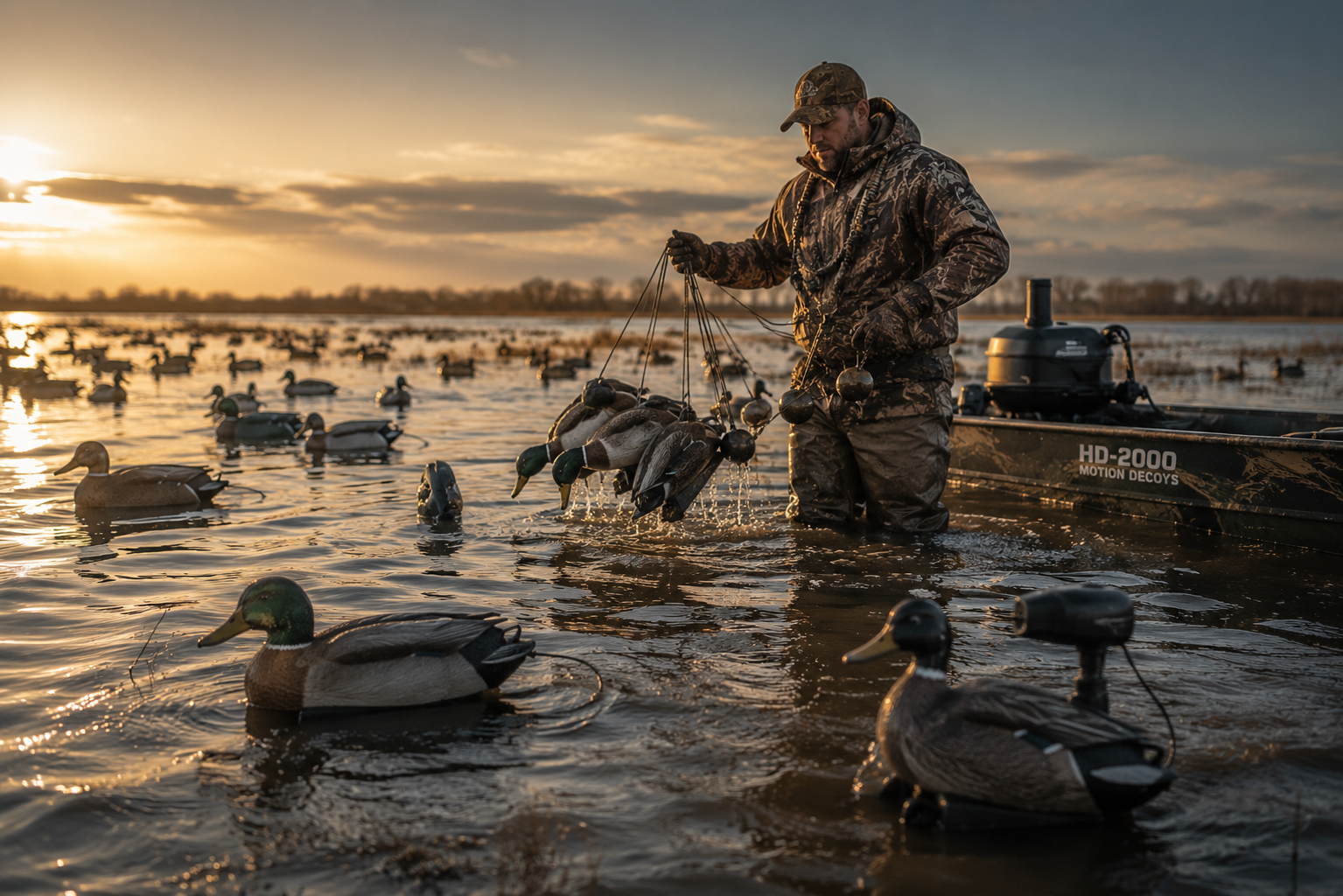
When the fierce pampas winds die down completely, the surface of an Argentine bañado (flooded pasture) turns to glass, forcing expert guides to deploy mechanical water-motion decoys and traditional jerk strings to prevent the spread from looking like lifeless plastic.
The Dead Water Dilemma
Ducks possess incredibly sharp vision designed to detect the microscopic ripples and splashes created by feeding waterfowl. On a windy day, the chop on the water naturally rolls the floating decoys, mimicking a live flock. On a dead-calm morning, a spread of 50 decoys sits perfectly motionless, casting unnatural, rigid reflections on the mirrored surface of the water. Incoming flocks of Yellow-billed Pintails will spot this anomaly from high altitude and flare instantly. Spinning-wing decoys (Mojos) provide flash, but they do not create the critical water ripples needed to sell the illusion to late-season, highly educated birds.
Motion StrategyExecution MethodTactical ResultSpinning-Wing (Mojo)Motorized, elevated pole.Long-range visual flash; does not move water.Splashing PulsatorsBattery-powered water pump.Creates continuous, heavy ripples in the center of the spread.The Jerk StringManual pull-cord attached to 3-4 decoys.The experienced Standard. Creates erratic, natural movement on command.
Deploying the Jerk String
Blind Concealment: The Art of Pampas Grass Camouflage
Defeating the hyper-vigilant eyesight of South American waterfowl requires Argentine guides to completely abandon generic, manufactured camouflage netting in favor of hyper-localized blind concealment utilizing native Cortaderia selloana, widely known as Pampas grass.
The Visual Superiority of Native Flora
Ducks perceive the world in high-definition, panoramic color. If a guide sets up a manufactured, olive-drab nylon pop-up blind in the middle of a golden, dormant winter pasture in Buenos Aires, the ducks will instantly recognize the geometric anomaly and flare at 80 yards. True concealment requires matching the exact texture, color, and movement of the immediate environment. Pampas grass is the complete architectural tool for this. It grows in large, towering clumps across the wetlands, featuring long, serrated leaves and huge, feathery white plumes. Because ducks see Pampas grass every day of their lives, utilizing it to brush a blind renders the hunters visually non-existent to incoming flocks of Yellow-billed Pintails.
| Concealment Material | Texture & Color Match | Effectiveness on Wary Ducks |
|---|---|---|
| Manufactured Camo Netting | Flat; often mismatched to local colors. | Poor. Looks like a dark geometric block in the field. |
| Imported Fast-Grass | Stiff; lacks natural movement. | Moderate. Works early season, fails on late-season birds. |
| Fresh Native Pampas Grass | Perfect color match; sways naturally in the wind. | Supreme. Completely breaks up the human silhouette. |
The Architecture of the Hide
The Sunken Bucket Blind: Hunting the Flooded Pastures
Executing a well-organized hunt in the shin-deep, flooded pastures (bañados) of Buenos Aires Province requires absolute concealment from the sharp eyes of dabbling ducks, prompting expert guides to utilize the highly effective, subterranean "Sunken Bucket Blind."
The Engineering of Invisibility
Unlike the deep-river deltas where hunters shoot from floating mud boats hidden in tall reeds, the flooded agricultural pastures of the pampas offer virtually zero vertical cover. The terrain is entirely flat. If you attempt to erect a popup tent or stand behind a manufactured grass panel, you will look like a large, dark geometric box against the horizon, and every Speckled Teal will flare at 80 yards. To achieve true invisibility, the hunter must go below the water line. Guides utilize large, heavy-duty plastic barrels (often industrial agricultural drums). They dig deep holes into the mud on the dry margins of the floodwater and sink the barrels vertically until the rim is perfectly flush with the ground.
| Blind Type | Visual Footprint | Tactical Application |
|---|---|---|
| Above-Ground Pop-Up | large. Casts a large, unnatural shadow. | Fails in flat, shallow-water pasture environments. |
| Floating Mud Boat | Large, but blends into tall, deep-water reeds. | Optimal for the deep Paraná River delta. |
| Sunken Bucket Blind | Zero. The hunter is below ground level. | The experienced Standard for the shallow Bañados of Buenos Aires. |
The Subterranean Execution
Related AWSORG Field Intelligence
- Duck Hunting in Argentina: Complete Guide
- Boats, Transfers & Safety in Argentina Duck Marshes
- Duck Calling in Argentina
Field Visuals