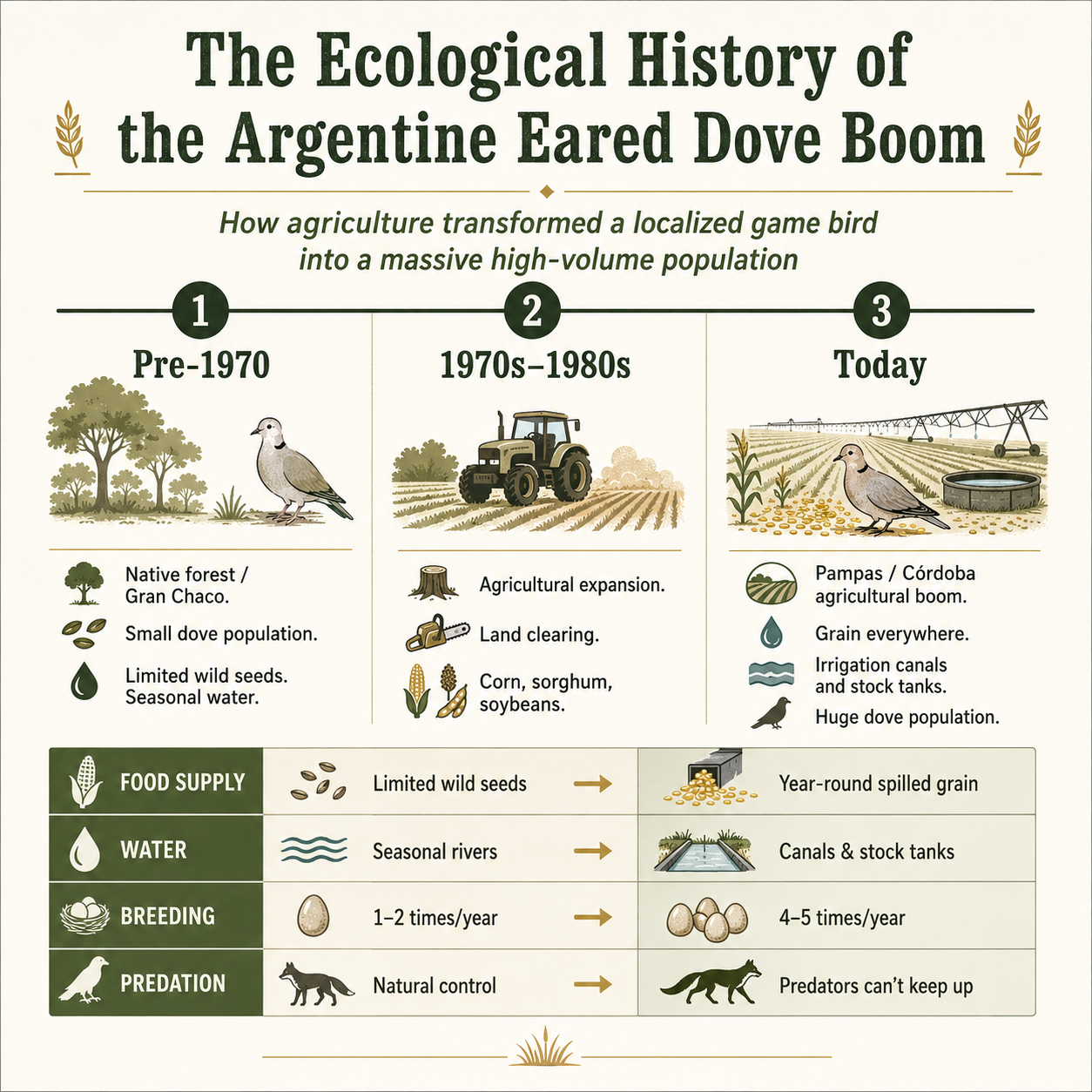
The status of Córdoba and the Argentine pampas as the undisputed global epicenter of high-volume wingshooting is not a natural historical phenomenon; it is the direct, spectacular result of an agricultural revolution that inadvertently created a 50-million bird ecological utopia.
The Pre-Agricultural Era
Before the mid-20th century, the Eared Dove (*Zenaida auriculata*) existed in Argentina as a standard, localized game bird with normal population levels. They lived in the dense, thorny native forests of the Gran Chaco and fed primarily on natural weed seeds and wild grasses. Their breeding was restricted by the harsh realities of nature: limited food supplies in the winter and intense competition for water. However, beginning in the 1970s and 1980s, the Argentine government and commercial farming syndicates initiated a massive agricultural expansion, clearing millions of acres of flat plains to plant high-yield cash crops—specifically corn, sorghum, and soybeans.
Ecological FactorNatural State (Pre-1970)The Modern Agricultural BoomFood SupplyLimited wild seeds; restricted winter calories.Millions of acres of spilled commercial grain; infinite calories year-round.Water AvailabilityScarce; localized to seasonal rivers.Thousands of man-made irrigation canals and stock tanks.Breeding Cycles1 to 2 times a year (Spring/Summer).4 to 5 times a year. Endless food triggers hyper-breeding.PredationControlled by natural forest predators.Foxes and hawks cannot keep pace with the hyper-inflated dove numbers.
The Perfect Biological Storm
This agricultural explosion created an accidental biological utopia. The farmers inadvertently provided an infinite, year-round caloric buffet directly adjacent to the impenetrable, thorny scrub forests where the doves roosted. Because the food supply never ran out and the climate was temperate, the Eared Dove ceased all natural migratory behaviors. They stayed put, and their biological reproduction went into overdrive. With access to endless corn and sorghum, a single pair of eared doves can now breed up to five times a year. Today, the population in provinces like Córdoba exceeds 50 million birds. They consume up to 30% of the local grain harvest, cementing their status not merely as a game bird, but as a severe, unprotected agricultural pest.
Tactical Field Note: Because the doves are legally classified as an agricultural plague, the Argentine government does not impose bag limits on them. The high-volume wingshooting industry serves as the primary pest control mechanism for local farmers, meaning your 1,500-round day is actively protecting the regional agricultural economy.
Internal Connections
- See the anatomy of where they live in The Anatomy of an Argentina Dove Roost.
- Understand how outfitters track this population in The Field Scout: How Lodges Track 50 Million Birds.
- Read about what happens to the meat in What Happens to the Birds? Meat Utilization in Argentina.