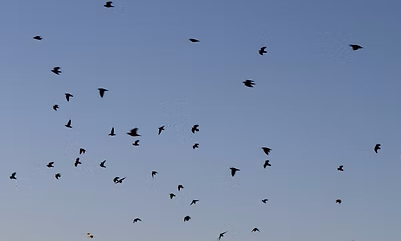
The unprecedented volume of dove hunting in Argentina is not an accident; it is the direct result of the Eared Dove's unique biology, which allows them to breed up to four times a year in the perfect, predator-free convergence of large agricultural feedlots and secure scrub-forest roosts.
The Biological Perfect Storm
In North America, the Mourning Dove migrates thousands of miles, faces harsh winters, and breeds only once or twice a season. The Argentine Eared Dove (Zenaida auriculata) is a non-migratory resident that has hit the biological lottery. In provinces like Córdoba and Entre Ríos, large commercial farming operations provide an infinite, year-round supply of high-protein grains (soybeans, sorghum, corn, and sunflowers). Because the birds do not need to migrate to find food, they expend very little energy. This caloric surplus, combined with the mild South American winter, allows a single pair of doves to breed and hatch multiple clutches of chicks every single year.
Biological FactorImpact on PopulationNon-Migratory BehaviorZero mortality from long-distance migration exhaustion.Hyper-Breeding CycleCapable of hatching 3 to 4 clutches annually.Infinite Food SupplyIndustrial agriculture provides year-round, high-calorie grain.Secure Roosting HabitatDense, thorny Chaco scrub protects nests from ground predators.
The Necessity of Pest Control
This unchecked biological engine has resulted in localized populations estimated between 30 and 50 million birds in single roosting areas (like the Macha hills in Córdoba). To the international hunter, this is a sporting paradise. To the Argentine farmer, it is an economic disaster. A large flock of eared doves can consume up to 30% of a farmer's commercial grain yield in a matter of weeks. Consequently, the Argentine government classifies the Eared Dove as a severe agricultural pest, eliminating bag limits and relying heavily on the international wingshooting industry to act as a vital method of localized population control.
Eared Dove vs White-Winged Dove: A Wingshooter's Comparison
For the international wingshooter, the dove stands as the complete test of reflexes and shotgun mechanics. While North American hunters are intimately familiar with the White-Winged Dove, those who travel to Argentina encounter a different adversary entirely: the South American Eared Dove. While they may share a family tree, their behavior in the field dictates completely different tactical approaches.
Migration vs Residency
The most significant biological difference between the two species dictates how and when they are hunted. The North American White-Winged Dove is highly migratory. Hunting them relies on intercepting seasonal flight paths, waiting for specific weather fronts, and capitalizing on a relatively short hunting season.
Conversely, the Eared Dove in Argentina is a resident species. Due to the infinite commercial food supply provided by the vast agricultural regions of the Pampas, these birds do not migrate. They stay in the same large roosts year-round and breed at an exponential rate. This permanent residency and staggering population density is exactly what fuels the world-famous, high-volume shooting industry in South America.
Flight Dynamics and Target Acquisition
When a hunter steps into a blind, the difference in flight style becomes immediately apparent.
- The White-Winged Dove: Tends to fly in smaller, predictable flocks. They typically hold a straighter, steadier flight line, making target acquisition and forward lead calculations relatively standard for an experienced upland hunter.
- The Eared Dove: Flies in chaotic, high-density swarms. They are notoriously erratic, executing sharp dives, riding the high winds of the plains, and instantly flaring at the sound of a shotgun blast or the sight of a hunter's face.
The Eared Dove's erratic flight path makes it a significantly harder target to track. Because the sky is often blackened by millions of birds, hunters frequently make the amateur mistake of "flock-shooting"—firing blindly into the mass of birds rather than isolating a single target.
Physical Size and Resilience
The White-Winged Dove is slightly larger and heavier than the Eared Dove, often featuring a broader wingspan. However, hunters should not mistake the Eared Dove's smaller stature for fragility. The Eared Dove is an incredibly robust, fast-flying game bird with dense plumage. When they are riding a strong tailwind over a harvested grain field, they require a perfectly placed shot string to bring down cleanly.
The Ecological History of the Argentine Eared Dove Boom
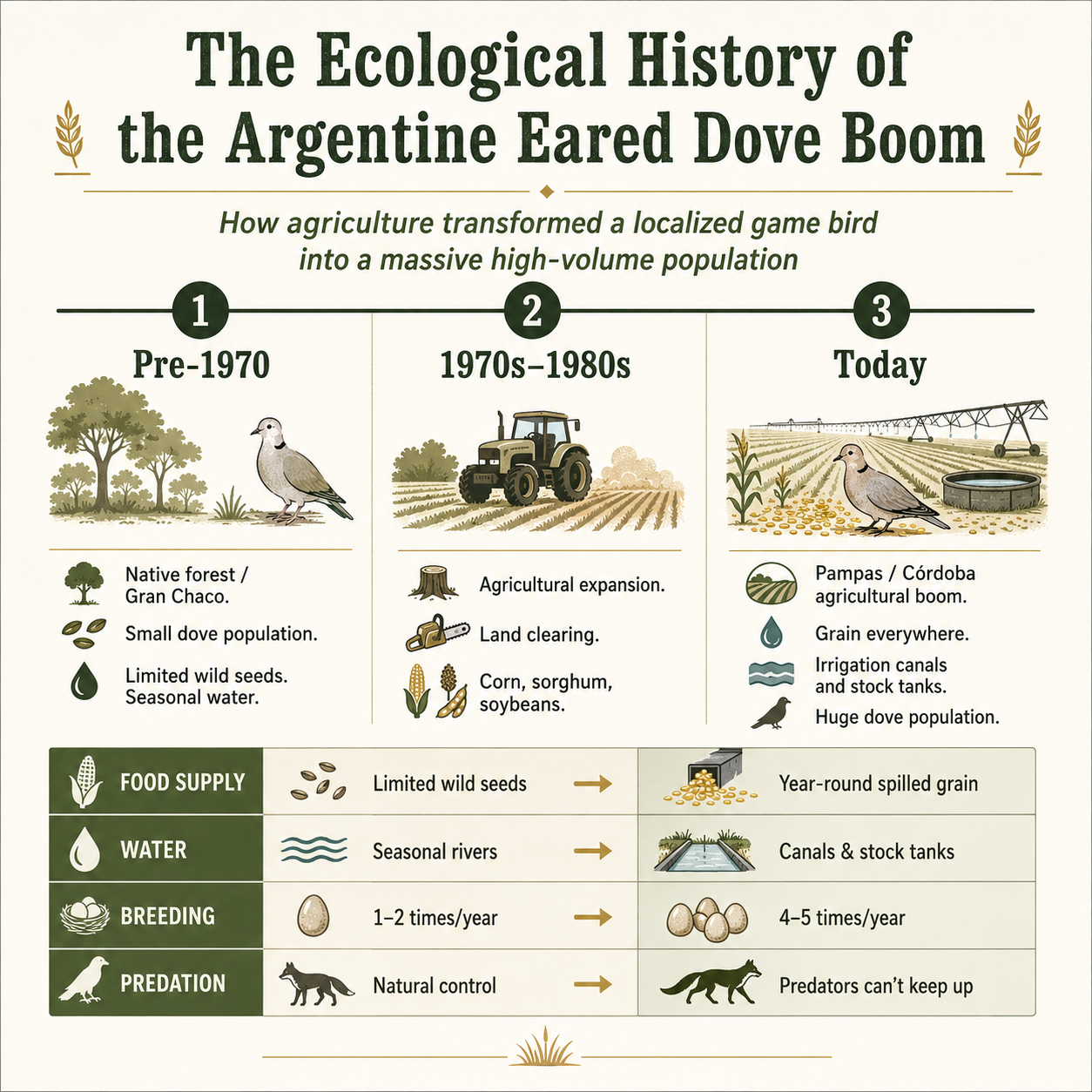
The status of Córdoba and the Argentine pampas as the established global epicenter of high-volume wingshooting is not a natural historical phenomenon; it is the direct, spectacular result of an agricultural revolution that inadvertently created a 50-million bird ecological utopia.
The Pre-Agricultural Era
Before the mid-20th century, the Eared Dove (*Zenaida auriculata*) existed in Argentina as a standard, localized game bird with normal population levels. They lived in the dense, thorny native forests of the Gran Chaco and fed primarily on natural weed seeds and wild grasses. Their breeding was restricted by the harsh realities of nature: limited food supplies in the winter and intense competition for water. However, beginning in the 1970s and 1980s, the Argentine government and commercial farming syndicates initiated a large agricultural expansion, clearing millions of acres of flat plains to plant high-yield cash crops—specifically corn, sorghum, and soybeans.
Ecological FactorNatural State (Pre-1970)The Modern Agricultural BoomFood SupplyLimited wild seeds; restricted winter calories.Millions of acres of spilled commercial grain; infinite calories year-round.Water AvailabilityScarce; localized to seasonal rivers.Thousands of man-made irrigation canals and stock tanks.Breeding Cycles1 to 2 times a year (Spring/Summer).4 to 5 times a year. Endless food triggers hyper-breeding.PredationControlled by natural forest predators.Foxes and hawks cannot keep pace with the hyper-inflated dove numbers.
The Perfect Biological Storm
This agricultural explosion created an accidental biological utopia. The farmers inadvertently provided an infinite, year-round caloric buffet directly adjacent to the impenetrable, thorny scrub forests where the doves roosted. Because the food supply never ran out and the climate was temperate, the Eared Dove ceased all natural migratory behaviors. They stayed put, and their biological reproduction went into overdrive. With access to endless corn and sorghum, a single pair of eared doves can now breed up to five times a year. Today, the population in provinces like Córdoba exceeds 50 million birds. They consume up to 30% of the local grain harvest, cementing their status not merely as a game bird, but as a severe, unprotected agricultural pest.
Related AWSORG Field Intelligence
- Dove Hunting in Argentina: Complete Guide
- Best Time for Dove Hunting in Argentina
- What to Pack and Wear for Dove Hunting in Argentina
- Weather, Crops & Dove Flight Patterns in Argentina
- High-Volume Dove Shooting Technique in Argentina
- Argentina Dove Hunting Cost & Shell Budget