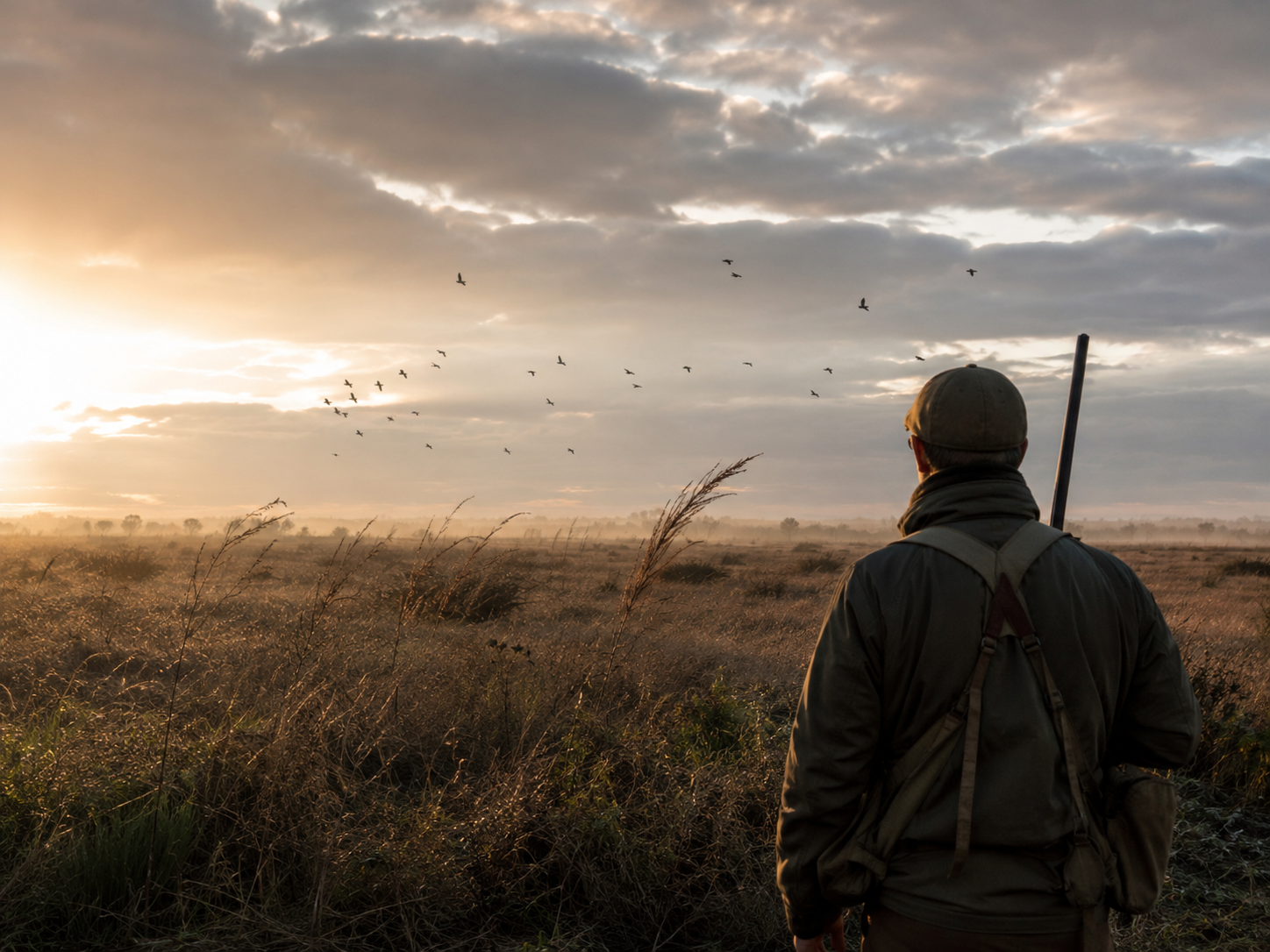
Dominating a high-volume Argentina dove roost requires hunters to seamlessly alternate their shotgun mechanics between two distinctly different ballistic challenges: the rapid, horizontal sustained lead of the crossing shot, and the blind, barrel-covering geometry of the incoming overhead shot.
The Fast Crossing Shot
When you are positioned on the edge of an agricultural feedlot, the majority of your engagements will be crossing shots. The doves are flying from left to right (or right to left) across your field of vision, often utilizing a tailwind to reach speeds of 40 to 50 mph. This requires a smooth, aggressive "sustained lead." You must mount the shotgun, push the muzzle ahead of the bird's flight path, match its speed, and pull the trigger while keeping the gun moving. The most common point of failure is stopping the barrel. If the shotgun stops moving the millisecond you pull the trigger, the shot string will pass harmlessly behind the dove's tail feathers.
Shot PresentationVisual FocusMechanical ExecutionCommon ErrorCrossing (Left to Right)The bird's beak.Push barrel ahead of the bird; maintain speed; follow through.Stopping the swing; shooting behind the bird.Incoming (Overhead)The bird's belly/chest.Start behind the bird, swing up *through* it, fire as the barrel covers the bird.Lifting the head off the stock to see the bird over the barrel.
The Incoming Overhead Shot
The incoming overhead shot—frequently encountered during the late afternoon as massive flocks return high to the timber roost—is the most psychologically difficult shot for a novice. As the dove flies directly toward and over your blind, you must execute a "swing-through" mechanic. You start the muzzle behind the bird, accelerate the barrel up through the bird's flight line, and pull the trigger exactly as the barrel completely blocks the bird from your vision. Because the human brain hates shooting at what it cannot see, hunters naturally lift their cheek off the stock to peek at the target, causing the muzzle to drop and the shot to pass harmlessly under the dove.
Tactical Field Note: If you are struggling with incoming overhead shots, instruct your bird boy to watch your cheek. A good loader will immediately diagnose if you are lifting your head. To fix it, bite down firmly on your back molars; this naturally locks your cheekbone tightly against the comb of the shotgun stock.
Internal Connections
- Read about managing your focus in The Mental Game of High-Volume Dove Hunting.
- Understand how wind alters these shots via Hunting Doves in High Winds: Tactics for the Pampero.
- Practice these skills using the The 100-Bird Streak: Accuracy Drills for High-Volume Doves.