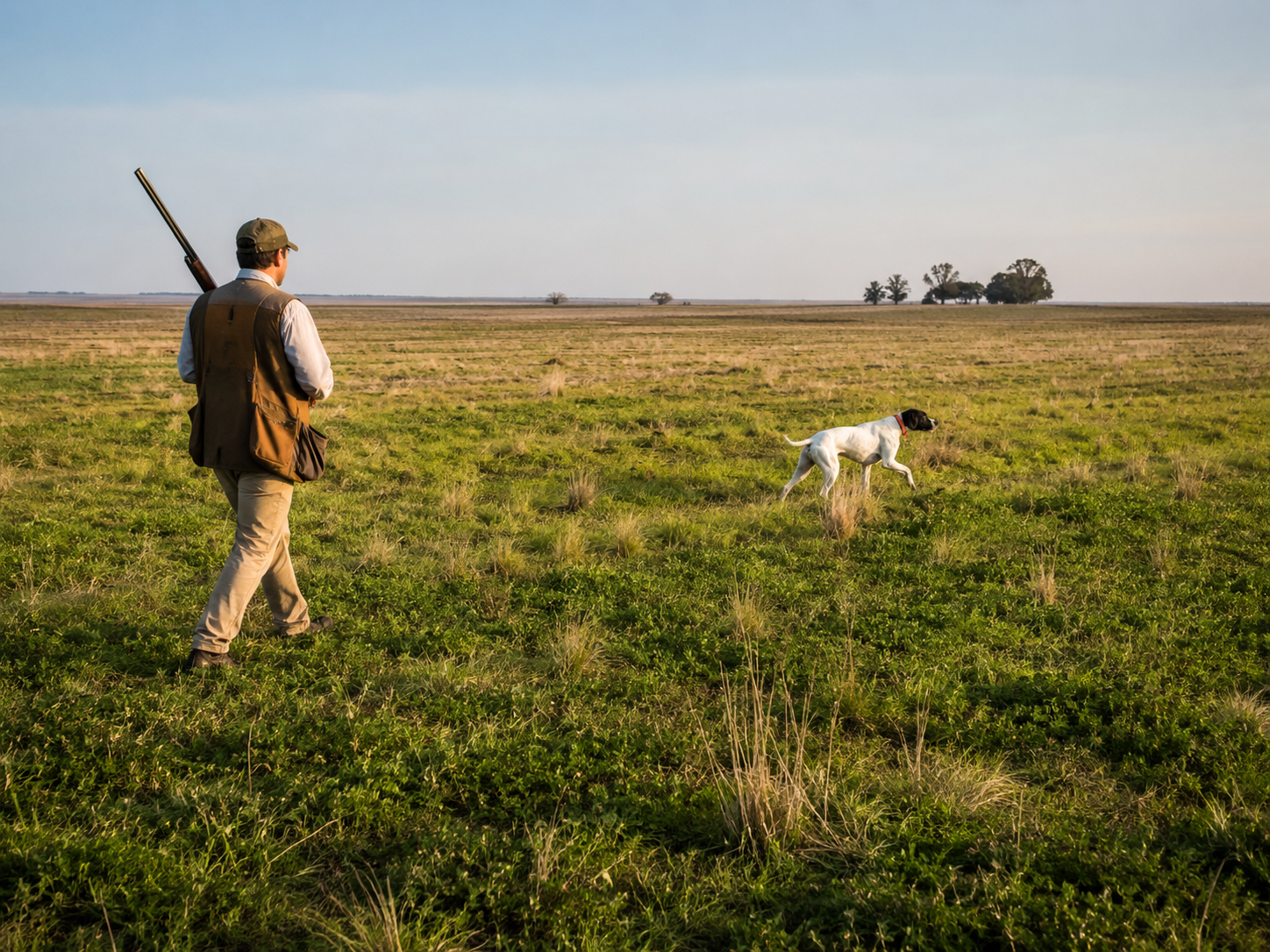
Mastering the flush of the Argentine Spotted Tinamou (perdiz) requires hunters to combat the bird's aggressive running behavior, maintain strict muzzle control, and execute a rapid, low-trajectory gun mount the millisecond the bird clears the winter alfalfa.
The Psychology of the Runner
Unlike pen-raised pheasants or tight-holding woodcock, the perdiz relies entirely on its legs to survive. When a German Shorthaired Pointer strikes a scent cone in the pampas, the perdiz will immediately attempt to sprint out of danger. If the dog is an experienced tracker, it will cast wide, cut off the escape route, and pin the bird down. This forces the hunter to walk briskly. The adrenaline builds as you approach the statuesque dog, knowing the bird is hiding somewhere within a 10-foot radius. The tension breaks instantly: with a startling explosion of wings, the solitary perdiz launches itself into the air, flying in a blazing, low, and incredibly straight trajectory.
| Flush Characteristic | Hunter's Tactical Response |
|---|---|
| Single Bird Launch | Focus 100% visual acuity on the single target; do not anticipate a covey. |
| Extremely Low Altitude | Maintain a low gun mount; never drop the muzzle toward the dogs. |
| Straight-Line Velocity | Push the barrel aggressively through the target; do not spot-shoot. |
| Explosive Takeoff | Carry the shotgun at the 'ready' (port arms); keep your thumb on the safety. |
The Patience of the Shot
The greatest error novice upland hunters make in Argentina is shooting too fast. Because the flush is so sudden and close to the hunter, the initial instinct is to pull the trigger immediately at 10 yards. If you hit a perdiz at this distance with an Improved Cylinder choke, the tight pattern will pulverize the meat, rendering it useless for the lodge chef. You must practice the discipline of the "pause." Mount the gun, acquire the target, and allow the fast-flying bird to push out to an ethical 20 or 25 yards. This allows your #7.5 lead shot pattern to fully open, ensuring a clean, meat-saving harvest.
How Much Walking is Required for Perdiz Hunting?
Executing a successful midday perdiz hunt in Entre Ríos Province requires international wingshooters to prepare for a brisk, sustained cardiovascular effort, typically demanding two to four miles of continuous walking across flat, uneven agricultural pastures to keep pace with the experienced pointing dogs.
The Mechanics of the Pampas Walk
Unlike the steep, brutal vertical inclines of North American Chukar hunting, the Argentine pampas are visually flat. However, 'flat' does not mean effortless. The terrain consists of winter alfalfa fields, heavy pasture grass, and harvested grain plots. The physical challenge of hunting the Spotted Tinamou (*perdiz*) is derived from the bird's survival instincts. They do not hide and hold tight like a bobwhite quail; they sprint aggressively ahead of the dogs. To prevent the bird from outrunning the scent cone, the dog handler (*perdicero*) must maintain a very fast, aggressive walking pace. Hunters must match this speed to ensure they are in position when the German Shorthair finally pins the bird.
Physical VariableReality of the Perdiz FieldHunter's PreparationDistance Traveled2 to 4 miles per 2-hour session.Ensure base cardiovascular fitness prior to the trip.Terrain SurfaceFlat, but uneven; hidden badger holes and thick clumps of grass.Wear lightweight, uninsulated leather upland boots for ankle support.Walking PaceBrisk and sustained; no casual strolling.Hydrate heavily before leaving the duck blind; do not over-layer clothing.Firearm CarryCarrying a shotgun at 'port arms' for two hours.Utilize a lightweight 20-gauge or 28-gauge double-barrel to save arm strength.
Managing Exertion During the Mixed Bag
The perdiz walk is strategically scheduled at midday (typically 11:00 AM to 1:30 PM). This timing allows the morning frost to melt, optimizing the scent conditions for the dogs. However, it also means you are walking during the warmest part of the winter day, often in full sun. You will be physically fatigued from waking up at 4:00 AM for the duck hunt. It is critical to shed all heavy waterfowl outerwear before stepping into the pasture. Wear only a breathable shooting shirt and briar-resistant pants to prevent large overheating and dehydration.
Why is Perdiz Hunting Always at Midday in Argentina?
Perdiz hunting in Argentina is exclusively executed during the midday hours to allow the heavy morning winter frost to melt, which unlocks the critical scent cones required by pointing dogs while perfectly bridging the gap between a freezing dawn duck hunt and an afternoon dove shoot.
The Biology of the Scent Cone
Upland hunting relies entirely on the olfactory capabilities of experienced pointing dogs, such as German Shorthaired Pointers and Brittanys. During the peak Argentine winter season (June and July), the Humid Pampa experiences severe, freezing overnight frosts. If you attempt to hunt perdiz at 7:00 AM, the frost traps the scent of the Spotted Tinamou close to the ground, making it nearly impossible for the dogs to track the fast-running birds. By 11:30 AM, the midday sun warms the pastures to a comfortable 55°F to 65°F. As the frost melts and the moisture evaporates, the rising thermals carry the perdiz scent into the air, allowing the dogs to cast wide and lock into rock-solid points.
| Time of Day | Environmental Condition | Impact on Perdiz Hunting |
|---|---|---|
| Early Morning (6 AM - 9 AM) | Heavy frost; freezing temperatures. | Poor scenting conditions; dogs struggle to track. |
| Midday (11 AM - 2 PM) | Sun warms the pasture; frost melts. | Optimal scent cone dispersion; perfect walking weather. |
| Late Afternoon (3 PM - 6 PM) | Temperatures drop; shadows lengthen. | Scent holds, but time is utilized for high-volume doves instead. |
The Tactical Schedule Pivot
Beyond canine biology, the midday perdiz walk is a masterpiece of mixed-bag scheduling. A 3-species itinerary demands extreme logistical efficiency. Hunters endure the freezing, static misery of the duck blind from 6:00 AM to 10:00 AM. Returning to the lodge to strip off heavy waders and step into lightweight leather boots provides immense physical relief. The two-hour midday perdiz walk serves as an active, cardiovascular warmup that stretches the legs and warms the body before sitting down to the heavy field Asado and transitioning to the static, repetitive recoil of the afternoon dove roost.
Safety Formations for Upland Perdiz Walking
Upland perdiz hunting in Argentina requires strict adherence to linear walking formations, dictating that two hunters and the dog handler move in perfect horizontal alignment across the pampas to ensure safe firing lanes and absolute protection for the experienced pointing dogs.
Walking the Pampas Line
Unlike dove hunting where you are stationed in a static blind, perdiz hunting is a dynamic, moving exercise. A typical deployment consists of one professional handler (perdicero), one pointing dog, and two shooters. The cardinal rule of the upland walk is "Hold the Line." The hunters must remain perfectly horizontal with the handler as they walk through the alfalfa. If one hunter lags 10 yards behind to take a drink of water, they instantly blind their partner's firing lane. When a bird flushes, the trailing hunter cannot safely swing their shotgun forward without sweeping their barrel across the leading hunter's back.
| Safety Protocol | Hunter Execution | Reason for the Rule |
|---|---|---|
| The Horizontal Line | Stay exactly level with your partner and the guide. | Ensures both hunters have a clear, safe 180-degree forward firing arc. |
| Muzzle Direction (Walking) | Carry shotgun at 'port arms' (muzzle up) or broken open. | Prevents accidental discharge into the legs or the dogs. |
| The Flush Window | Only shoot birds flying forward and outward. | Never swing backward; a trailing bird is a safe bird. |
| The Dog Zone | Never drop the muzzle below the horizon line. | Perdiz fly low; shooting too early endangers the jumping dog. |
Approaching the Point
When the German Shorthair locks into a solid point, the adrenaline spikes, but discipline must remain absolute. The guide will signal the hunters to approach. You must walk up to the dog slowly, maintaining your horizontal line with your partner. The guide will dictate which hunter has the primary shot based on the bird's flush direction. If the bird flushes to the left, the left hunter shoots. If the bird flushes low and straight away, you must mount the gun, track the bird, and physically wait a full second to ensure the bird has cleared the vertical height of the dog before pulling the trigger.
Wind Tactics for Perdiz Hunting
Executing a well-organized perdiz hunt in Argentina relies entirely on meteorological geometry; the professional *perdicero* must maneuver the pointing dogs across the vast alfalfa pastures in strict relation to the prevailing wind to intercept the invisible, drifting scent cone of the running Spotted Tinamou.
The Geometry of the Scent Cone
Unlike humans who rely on sight, experienced German Shorthaired Pointers hunt via a three-dimensional plume of odor (the scent cone) that drifts downwind from the bird. If the *perdicero* (handler) directs the dog to run directly with the wind at its back (a tailwind), the dog will outrun the scent cone and physically bump the bird into a wild flush before ever establishing a point. To hunt effectively, the handler will always start the hunters at the downwind edge of the pasture and cast the dog into the wind (a headwind) or across the wind (quartering). This allows the dog to hit the scent cone like an invisible wall, instantly freezing into a rigid point before the bird realizes it has been detected.
| Wind Direction (Relative to Hunters) | Canine Tactical Response | Hunter Execution |
|---|---|---|
| Headwind (Wind in face) | Optimal. Dog tracks straight into the scent; hard, definitive points. | Walk steadily behind the dog; flush will generally quarter away. |
| Crosswind (Wind from the side) | Excellent. Dog casts in wide zig-zags (quartering) to locate the cone. | Maintain the horizontal safety line; prepare for sharp lateral flushes. |
| Tailwind (Wind at back) | Poor. Dog outruns the scent cone; birds are bumped randomly. | Avoid this setup. The guide will re-position the group to the other side of the field. |
The Hunter's Approach
When the dog hits the scent cone and locks up, the wind dictates how the hunters must approach the point. If there is a strong crosswind from the left, the scent is blowing to the right. This means the actual perdiz is likely sitting 10 to 15 yards to the left of where the dog is pointing. The perdicero will instruct the hunters to approach slightly offset from the dog to 'trap' the running bird. The shooters must walk in with shotguns at the ready (port arms), entirely focused on the grass ahead of the dog, anticipating an explosive, low-altitude launch.
Alfalfa vs Natural Pastures: Reading Perdiz Habitat
Executing a well-organized midday upland hunt in Argentina requires hunters and their pointing dogs to adapt their tracking tactics as they transition from the dense, moisture-rich alfalfa fields to the fast, arid expanses of natural winter pastures.
The Dense Alfalfa Scent Trap
In Buenos Aires and Entre Ríos, commercial alfalfa fields act as magnets for the Spotted Tinamou (*perdiz*). Alfalfa provides a large canopy of protein-rich leaves and vital insect life. For a German Shorthaired Pointer, hunting alfalfa is highly productive but physically demanding. The thick, green vegetation traps moisture from the morning frost, creating a large, concentrated scent cone. Because the cover is so thick, the perdiz feels secure and will often "hold tight" rather than running aggressively. Dogs will lock into rigid points quickly, resulting in very close, explosive, vertical flushes as the hunters step directly into the vegetation.
| Habitat Variable | Commercial Alfalfa Fields | Natural Winter Pastures (Pampas) |
|---|---|---|
| Vegetation Density | Thick, green, moisture-rich canopy. | Thin, dry, short yellow winter grasses. |
| Scent Conditions | Excellent; moisture holds the scent cone in place. | Challenging; dry air dissipates scent quickly. |
| Bird Behavior | Holds tight; flushes only when pushed closely. | Runs aggressively; relies on speed over camouflage. |
| Canine Tactic | Slower, methodical quartering; tight points. | Wide, high-speed casting to cut off running birds. |
The Dry Pampas Sprint
When the *perdicero* (dog handler) moves the line into a natural winter pasture—characterized by short, dry, yellow grasses and sparse thistles—the tactical dynamic changes instantly. Without the thick canopy to hide them, the perdiz relies entirely on its legs. As soon as the bird hears the hunters approaching, it will sprint in a straight line. Because the dry winter air dissipates scent rapidly, the pointing dog must cast very wide and run incredibly fast to intercept the moving scent trail before the bird escapes. Hunters must increase their walking pace significantly, keeping their shotguns at the ready (port arms), as the bird will often flush 20 yards ahead of the dog in a low, blistering horizontal trajectory.
Taking Turns: Etiquette and Safety on the Perdiz Walk
Hunting the Spotted Tinamou (*perdiz*) in Argentina is a highly orchestrated, two-man upland deployment; maintaining absolute safety and sporting etiquette requires hunters to strictly alternate firing opportunities over the pointing dog.
The Two-Man Safety Line
In high-volume dove roosts, hunters are separated into individual, stationary blinds. In the perdiz field, you are walking as a mobile, dynamic unit. A standard upland group consists of one *perdicero* (dog handler), one pointing dog, and exactly two hunters. The golden rule of the pampas is the "Horizontal Line." The two shooters must remain perfectly parallel with the guide at all times as they sweep the alfalfa pasture. If one hunter lags 10 yards behind to take a drink of water, they break the safety line, creating a severe crossfire hazard if a bird suddenly flushes backward or laterally.
| Upland Scenario | Correct Hunter Action | Safety/Etiquette Violation |
|---|---|---|
| Dog Goes on Point | Both hunters walk in parallel; designated shooter steps slightly forward. | One hunter sprints ahead to steal the flush. |
| Bird Flushes Left | The left-side hunter takes the shot. | The right-side hunter shoots across the guide's face. |
| Bird Flushes Low | Hold fire; let the bird climb above the dog's head. | Shooting immediately; endangering the pointer. |
| Bird is Downed | Break open the shotgun action; allow the dog to retrieve. | Walking forward with a closed, loaded gun. |
The Etiquette of the Flush
Because the daily limit for perdiz is highly restricted (typically 6 to 10 birds per hunter), every point is a prized event. Hunters must establish a clear rhythm of taking turns. If the dog points, Hunter A is the designated shooter. Hunter B keeps their gun at the "port arms" position but does not mount or fire unless Hunter A completely misses and calls out for a backup shot. On the next point, the roles reverse. Furthermore, you must respect the dog. The flush of the perdiz is notoriously low to the ground. If the bird does not climb to a safe vertical height, the designated shooter must immediately lower their barrel and let the bird fly away, prioritizing the life of the canine athlete over a single bird.
The Solo Perdiz Walk: Upland Tactics for the Single Gun
While typically executed in pairs, deploying as a solo hunter on an Argentina perdiz walk offers the complete purist experience, providing complete tactical control of the firing line and an unfiltered 1-on-1 connection with the experienced pointing dogs.
The Geometry of the Single Gun
In a standard two-man upland formation, hunters must split the field of fire. The left hunter takes birds flushing left; the right hunter takes birds flushing right. This requires constant peripheral awareness of your partner's position to maintain the safety line. When you book a solo trip (or your hunting partner decides to skip the midday walk to enjoy the lodge spa), the entire geometry of the pasture opens up to you. As the single gun walking behind the *perdicero* (dog handler), you own a large 180-degree firing arc. You no longer have to hesitate or check your partner's position when a Spotted Tinamou flushes sharply across the scent cone. You have absolute freedom to mount, track, and fire instantly.
| Tactical Element | Two-Man Formation | Solo Hunter Formation |
|---|---|---|
| Field of Fire | Restricted (Split 90-degree arcs). | Absolute (Full 180-degree horizontal clearance). |
| Walking Pace | Dictated by the slowest walking partner. | Customized entirely to your cardiovascular comfort. |
| Shot Opportunities | Divided; taking turns on points. | 100% volume; you take every flush the dog produces. |
| Safety Management | High stress; must constantly monitor partner's barrel. | Low stress; only need to avoid the dog and handler. |
Maximizing the Pointer Synergy
Noise Discipline: Silence in the Argentine Perdiz Pasture
Executing a successful midday perdiz hunt requires international wingshooters to adopt strict acoustic discipline; excessive talking or shouting in the upland pasture shatters the focus of experienced pointing dogs and causes the Spotted Tinamou to flush wildly out of range.
The Acoustic Sensitivity of the Pampas
In a high-volume dove roost, the noise is deafening. Hunters yell to their hunting assistants, joke with adjacent blinds, and fire thousands of rounds. When you transition to the upland perdiz walk, you must completely flip your mental switch. The Argentine pasture is a game of stealth and sensory tracking. The Spotted Tinamou (*perdiz*) has exceptional hearing. They are heavily preyed upon by foxes and hawks. If two hunters are walking 20 yards behind the German Shorthaired Pointer and loudly discussing business over the wind, every perdiz in a 100-yard radius will hear them. Instead of holding tight in the alfalfa for the dog to point, the birds will immediately sprint far out of shotgun range and flush "wild," completely ruining the setup.
| Hunter Action | Impact on the Bird (Perdiz) | Impact on the Pointing Dog |
|---|---|---|
| Loud Talking / Laughing | Bird sprints away early; wild, out-of-range flushes. | Distracts the dog from the subtle scent cone. |
| Whistling at the Dog | Negligible (birds ignore whistles). | Catastrophic. Confuses the dog; conflicts with the handler's commands. |
| Silent, Steady Walking | Bird feels hidden and "holds tight" in the grass. | Dog remains entirely focused on tracking the invisible scent trail. |
Respecting the Perdicero's Command
How Weather Affects Pointing Dog Scent Trails in the Pampas
Executing a well-organized midday perdiz walk requires hunters to understand the invisible micro-climate of the Argentine pasture, as shifting barometric pressure, morning dew, and high winds drastically alter how pointing dogs perceive scent trails.
The Chemistry of the Scent Cone
A German Shorthaired Pointer does not track a Spotted Tinamou (*perdiz*) by sight; they track microscopic skin rafts and oils left behind by the bird as it moves through the grass. The visibility of this "scent cone" to the dog is dictated entirely by moisture. Water molecules act as a binding agent, trapping the bird's scent close to the ground and keeping it concentrated. In the late morning (around 10:30 AM), the melting pampas frost and heavy dew create the complete scenting environment. The wet alfalfa holds the scent trail perfectly intact, allowing the dogs to track the perdiz with laser precision and lock into beautiful, rigid points directly over the holding bird.
| Weather Variable | Impact on the Scent Trail | Canine Tactical Performance |
|---|---|---|
| Heavy Morning Dew / Melting Frost | Optimal. Traps and holds scent to the vegetation. | Pinpoint accuracy; dogs can track running birds effortlessly. |
| Dry, Hot Midday Sun | Poor. Evaporates moisture and burns off scent rafts. | Dogs struggle to locate birds; scent vanishes quickly. |
| High Winds (The Pampero) | Erratic. Blows the scent cone sideways across the field. | Dogs will point 20 yards away from the actual bird; false points increase. |
The Dry Wind Challenge
The tactical dynamic shifts dramatically if you are hunting in the early afternoon during a dry, high-wind event. When the *Pampero* wind blows across the arid, short-grass winter pastures, it actively strips moisture from the ground. The dry air destroys the scent trail rapidly, and the high wind physically blows the scent cone yards away from where the perdiz is actually hiding. In these conditions, you will notice the pointing dogs casting much wider and moving erratically. When the dog finally locks on point, the bird may actually be 15 yards to the right of where the dog's nose is aiming. Hunters must adapt by keeping their shotguns at the ready, anticipating a wild, flushing bird from an unexpected angle.
The Walk-Up: How to Safely Approach a Pointing Dog
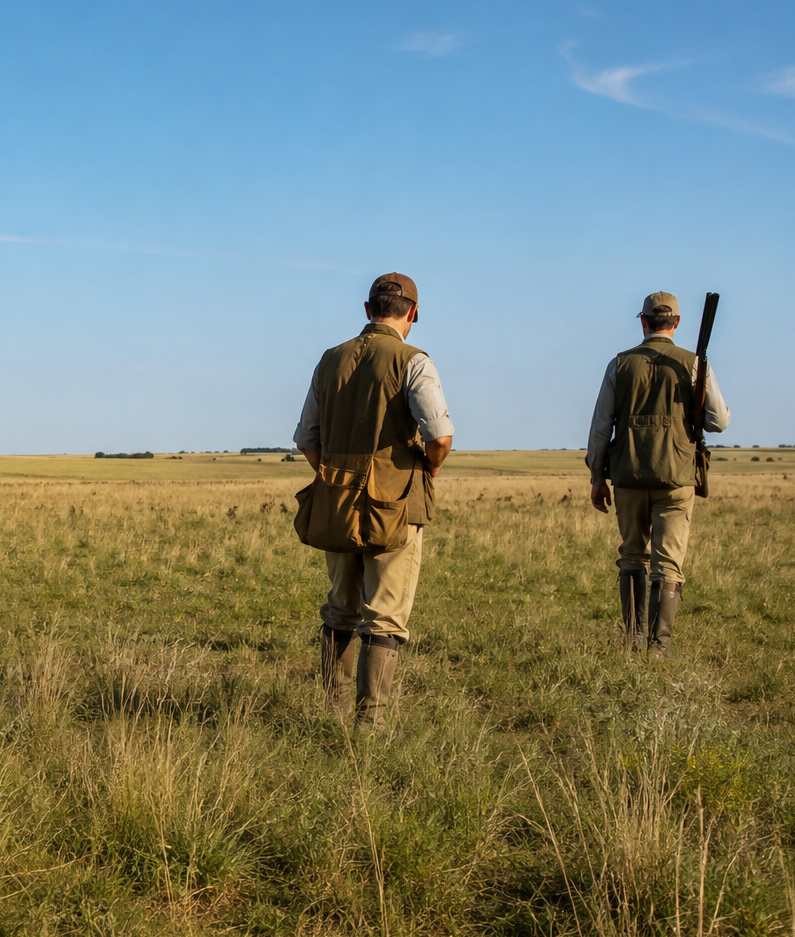
When a German Shorthaired Pointer locks into a rigid, statuesque point in the Argentine alfalfa, the transition from walking to shooting requires the two-man hunter team to execute a well-organized, synchronized approach to prevent catastrophic crossfires.
The Geometry of the Approach
The moment the dog stops and points, the adrenaline spikes. The Spotted Tinamou (*perdiz*) is holding in the grass, often just inches from the dog's nose. The greatest safety violation a hunter can commit is breaking the horizontal safety line by sprinting ahead of their partner to get a "better angle" on the dog. You must maintain the line. When the *perdicero* (handler) signals the point, both hunters must walk forward at the exact same pace, keeping their shotgun barrels pointed strictly at the sky (port arms). You do not mount your shotgun until the bird physically leaves the ground.
Phase of the PointThe Hunter's ActionThe Safety Mandate1. The Dog Locks on PointStop walking; identify your partner's exact position.Keep the shotgun action closed but the safety engaged; muzzle to the sky.2. The Synchronized Walk-UpBoth hunters step forward slowly, perfectly parallel.Never break the horizontal line. Do not step in front of your partner.3. The FlushThe designated shooter mounts the gun and acquires the target.If the bird flushes laterally across your partner, you must hold fire.
The Shooter's Step
As you approach the dog, the bird will eventually break its nerve and flush. If it is your turn to shoot, you execute the "Shooter's Step." While remaining generally parallel with your partner, the designated shooter is permitted to take one half-step forward and slightly outward (away from the dog) just as the bird flushes. This creates a tiny, safe geometric window, ensuring your muzzle is pushed cleanly out in front of your partner's face and well clear of the dog handler. If the bird flushes straight up but stays dangerously low to the dog's head, you must immediately dismount the shotgun and verbally declare "No shot," prioritizing the life of the experienced canine athlete over a single perdiz.
Related AWSORG Field Intelligence
- Perdiz Hunting in Argentina: Complete Guide
- What to Wear and Pack for Perdiz Hunting in Argentina
- Perdiz, Martineta and Upland Species in Argentina
- Pointing Dogs and Dog Handling for Argentina Perdiz
- Argentina Perdiz Season, Limits & Regulations